Civilization is a kind of recursive, iterated potty training.
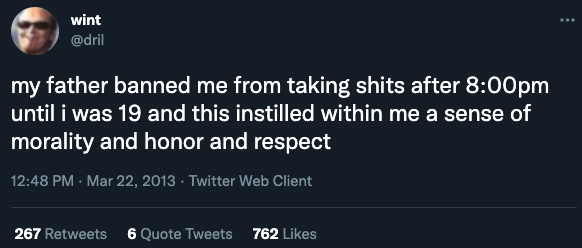
See, the great thing about being an uncivilised barbarian is that you can shit wherever you like, whenever you like. This works out fine in the open wilderness, but it doesn’t work when you have lots of people in a small amount of space. Then shit just piles up everywhere, it stinks, and worse, people get sick, and die. So our predecessors developed some rules. You will shit in these designated locations, or else!
These sensible regulations are not without cost to the individual. Potty training means learning to suppress your body’s natural instincts and impulses, so that you can shit on command, according to schedule. And the schedule is not designed for you. It’s designed for the convenience of others. Ideally, it’s for the convenience of “everyone”, and the limitations imposed on your personal freedom are supposed to be smaller than the net increase in freedom that you have from participating in a functioning society.
Ideally.

In practice, society is far from well-governed. We might consider ourselves more enlightened than our predecessors, but our descendants will surely think of us as senseless brutes in exactly the same way. People in positions of authority often get drunk on power and abuse the privilege of their position to direct people according to their own whims and fancies, rather than what they discern to be best for everyone. And even when good people somehow end up in such positions, and they actually try their best, they are often hamstrung by factors beyond their control, and the sheer unimaginable complexity of the systems that they operate in, where trying to do good here might result in unfathomably bad outcomes over there. Large scale problems cannot be solved by benevolent rulers alone – we require the coordination of many good people.

My friend Florent Crivello (@Altimor) wrote a blogpost in 2019 where he introduced the concept of the Tough Tomato Principle. Here’s how I understand it. Over time, tomatoes have been bred to survive the industrial process that they are subjected to: mechanical harvesters, transportation and so on. Flavor and nutritional quality are secondary to machine compatibility. Because these tough tomatoes are able to survive a much more brutal industrial process, they can be sold more cheaply, in large quantities. And most consumers end up choosing the cheaper tomatoes. So, more or less, we end up living in a world where the tomatoes in your local supermarket (and to be clear: every supermarket is a marvel of civilization!) are more tough than delicious.
Is that good or bad? It’s debatable. It is what it is. What I’m trying to convey is that we too are tough tomatoes. That’s what the potty training is about. We are “less delicious” than we could be, because of tradeoffs that were made before we were born. Some people put on their tinfoil hats when talking about this, arguing that there’s a secret cabal of people conspiring to keep us dumb, fat, tired, anxious and indebted, so that we won’t ask any questions but instead focus on being obedient workers and good consumers.
My read of the situation is a little more subdued. I don’t think any master conspiracists are necessary. It’s just a tradeoff that people have collectively made, largely through informal mechanisms. There is no conspiracy to make tomatoes tasteless – the goal was really just to make tomatoes profitable, and the relative tastelessness is just a tradeoff that was chosen in pursuit of profit. If anybody could figure out how to make tomatoes simultaneously tough and tasty, that would quickly become the new default.
Anyway, the cool thing is: unlike tomatoes, we have some degree of influence over our constitutions. We can identify the ways in which we have been programmed by our contexts, and we can modify our programming to a significant degree. That’s a big part of what INTROSPECT is about: identifying the ways in which you have been conditioned, and unlearning what is not helpful to you, to make space to learn what is helpful to you, so you can become as delicious and juicy of a tomato as you want to be.
✱
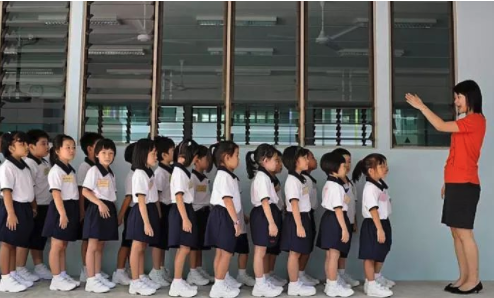
School felt like a prison to me. It wrenched my shoulders and twisted my guts and gave me all sorts of issues that I had to spend years resolving. My early childhood was defined by the adventure of reading whatever I wanted, whenever I wanted, so being made to sit in a classroom and “pay attention” was the cruelest torture for me. Why should I “pay attention” to something that isn’t interesting to me?
I’ve come to believe that the way we coerce people into paying attention in school is the beginning of dysfunction for lots of people. They learn that attention is something that you can demand of others. And they internalize this, and become bullies even to themselves.
I’ve found that lots of good people are able to be kind to others, but in private they continue to be cruel to themselves. Why is that? And how is it to be addressed? (That’s also something I’ll dig into deeper throughout my book!)
✱

Friends are sometimes surprised to hear that I found 2 years of mandatory conscription in Singapore to be less prison-like than school. I never get nightmares about being a soldier! Why? I think because people weren’t as dishonest about the nature and role of the military. When you’re told to stand at attention in the military, it makes sense. It’s part of the regimentation that’s necessary for the effective functioning of a unit. I found it easier to accept.
Relative to that, the regimentation of attention in school felt like a power trip on the part of the adults. I understand that it’s hard to be a teacher managing a large classroom – I have a lot of respect and admiration for anybody who chooses to be a teacher, and tries their best, even though the situation in a lot of schools makes it such that teachers barely get to do any real teaching.
I felt a real sense of joy getting out of school, and had a blissful few self-directed months before my military service. And actually, I had a remarkable amount of free time in the army to do my own reading and pursue my own interests on the side, which I found a lot of joy in.
After I left the military though, at 22, I got married, got a mortgage, and found myself feeling helplessly saddled with responsibilities. I loved my wife tremendously (still do!), and I was even blessed to get hired by a really forward-thinking startup with great colleagues. But despite that, I sank deeper and deeper into a depression. Life simply felt like a relentless onslaught of responsibilities, bills, todo lists, things I struggled to keep up with. My friends my age were mostly unmarried and studying in University, so it felt like there was a chasm between us.
When I talk about the struggle of transitioning into working adult life, though, a lot of people tell me that they feel similarly – the specifics of our struggles may be different, but there’s this overarching sense of “this is it, from here on life becomes a ceaseless struggle”. You might say that some adults do try to warn children about this, but few of them are really good at relating it well, and maybe it’s not possible to understand until you feel it yourself.
If you’re not careful, everyday life can become a sort of psychic prison, held together with assumptions that go unquestioned because you’re just so busy and tired all the time. The mind can function as a sort of homeostasis engine – a machine that works to keep things predictable and familiar. (We’ll talk about this more later re: “The Propaganda Department of the Mind”.) It’s probably meant to keep you safe and to keep you from wasting energy, but it can overoptimize for this at the expense of your quality of life. “Quality of life” sounds like such a clinical phrase. I’m talking about the fundamental joy of living. When you lose that, what’s the point of anything else?
I really feel like we don’t discuss this enough, and that loads of people are struggling quietly, lashing out at each other about peripheral things with disproportionate vengeance because they’re so burdened and lonely.
✱
The man’s been in here 50 years. This is all he knows. In here, he’s an important man. He’s an educated man. Outside, he’s nothing. Just a used-up con with arthritis in both hands. Probably couldn’t get a library card if he tried. […] I’m telling you, these walls are funny. First you hate ’em. Then you get used to them. Enough time passes, you get so you depend on them. That’s institutionalized.”
– Red, The Shawshank Redemption (1994)
Everybody is dealing with constraints. The thing I’ve found about people who are really suffering, though, is that they find their constraints to be suffocating and insurmountable. It just seems so impossibly, incomprehensibly large and complex, which makes it seem inescapable. And so many people, after suffering the pain of defeat several times, give up.
Many people decide to settle for some sort of compromise with their psychological captors – the classic “freedom for security” trade. “It’s okay if I’m miserable because life is miserable. My joy is not important. There are more important things than my happiness.”
Let’s be real: there are some people whose circumstances are so terrible that this is almost the only choice they have. I hear this a lot from the children of immigrant parents, people whose parents or grandparents survived war, occupation, colonization and so on. The spirit of life is worn thin, reduced to a flicker. It’s very sad to see. And you can’t help them all.
But you can try to help yourself, and try to be an example for others in your life so that they might help themselves too.
✱
The above post was originally a chapter of my 2nd ebook, INTROSPECT, which I hope to publish before December 2021!! It kind of spiralled into something bigger and wider than I originally intended, so I figured I might as well publish it as a blogpost instead.