Usually, if you ask someone to imagine a narcissist, the first image that comes to mind is someone enjoying how they look. Someone who loves the sound of their own voice, someone who loves attention, being seen. That’s broadly accurate.
But I want to also add that sometimes it can actually be more narcissistic to be private rather than public, in the sense that one might want to protect one’s self-image from scrutiny.
Narcissism is a convoluted concept, and it’s worth disambiguating.
The first thing I find myself thinking is that people have different bandwidths. A person can have a very large bandwidth and care a lot about themselves AND a lot about others, simultaneously. These people are often described as “larger than life”.
A person might also be “smaller than life” – either “naturally”, or as a conscious decision – taking great pains to avoid scrutiny, avoid taking up space in public, avoid being seen or heard. This can be part of a sort of narcissism in itself, though few would call it that.
The other important variable other than self-concern is concern for others. Many seem to think of this as a balancing act – like we have a limited amount of concern and we have to allocate it say 50/50 self vs others, or 60/40 or whatever. It breaks down if you interrogate it closely.
Some people use their smallness and seeming insignificance as a justification for not having to care about others, not being interested or concerned about others. Just kinda anonymously ghosting and coasting through life with minimal fuss. (Not judging! Just observing)
Some people care deeply about others to the point of being self-sacrificial. If they’re skilled about it, it can be a good life, but if they’re not, this way of being also ends up leading to “unforeseen” problems and failures that somebody has to deal with.
I think the global default good life script is something like… care about your family, care about your community, meet your obligations on those fronts, do a little extra for them if you like, get by, indulge in something you enjoy from time to time, don’t be a dick, die happy. See Steve Jobs’ quote about “Try not to bash into the walls too much.”
This is a sort of “basic life”, and if you live a good basic life that’s genuinely something to be proud of, IMO. There is so much cruelty and toxicity in the world – if you manage to avoid giving in to that, and you help someone out now and then, I love you and I’m proud of you.
Where I think all of this starts to get interesting is this:
Everyone has some script or set of beliefs about what is appropriate, what is good, what is right. And if you’re reading this, you are certainly going to run into people who have different scripts, different beliefs.
So for example, a person who believes that life should be small and unobtrusive might see another person living large, and accuse them of being “narcissistic”. Even though the second person might actually do more and care more for others than the first person ever does!
And that isn’t necessarily “wrong” either; it’s just that different people have different models and different ideas about what is good and what is right and what is an “appropriate” way to be; we are all projecting from our experiences + received wisdom + reflections and so on.
A phrase I’ve found myself using repeatedly is “narcissists ruin self-love for the rest of us”- ie there are people who are troublingly self-obsessed + troublingly indifferent to the needs of others, and their actions & behaviors can unfortunately be contaminated by association.
I think the accusation of narcissism carries ostracizing undertones – ie “that guy is selfishly self-obsessed, ew, people like us don’t do things like that.”
And I think people in general, being social creatures, are wary of being ostracized. Which is quite rational.
So I’m increasingly convinced that people who are mean to themselves do it as a sort of anti-ostracization defense. Many people unfortunately apologise for promoting their own work &are wary of celebrating themselves lest they be ostracized as narcissists. (There is a gendered aspect to this.)
If you possess talents and abilities that you want to use in service of others, you will quite probably find yourself in the confusing position of having to advocate for yourself. Maybe run for office, maybe seek a leadership role. Take on more responsibility, influence outcomes.
It’s very easy to say “that guy is great, everyone should hear what he has to say.” It’s much more difficult to say “people should listen to me”.
And it’s interesting (& troubling) to consider how this social complication is a bottleneck that keeps out highly-qualified people.
Put it this way: our weird hangups about narcissism perpetuate a self-fulfilling prophecy where arrogant egotists are often overrepresented, and thoughtful, doubtful folks are often underrepresented. And then we go, “Aha, see, only narcissists run for office!” (for example).
One simple and effective way to avoid a lot of this problem is to be a great wingman to your friends and peers. A group of peers who are sincere and honest about what’s good creates a scene that accelerates the production of high-quality output.
This sidesteps the 1-to-many problem, but it still doesn’t quite help with the 0-to-1 problem. Before you can create work that others rave about, you first have to create work. & this itself is something some people find narcissistic, which is an unfortunate inhibitation.
Anyway I’m running out of steam and should get to bed. But as a closing thought, simply consider this frame: we should be honest with ourselves & each other about what’s good, and we should challenge + support each other (and ourselves!) to do great work.
The galaxy-brain take for those who want to go there: the self is itself an illusion anyway; we are but fleeting assemblages and all our work is necessarily derivative. Narcissism then is a sort of bug, a hallucination; a fixation on a thing that isn’t even actually there.
✱
Narcissists don’t love themselves
I think the idea that “narcissists are in love with themselves” is a a misleading, inaccurate concept
I think narcissists are obsessed with enforcing validation of a static image of themselves. this is a fearful state of mind that leaves little to no room for actual love at all
actual love is patient, kind, generous, gentle, happy, cheerful, open to surprise
“I must make everything about me” is not love. that’s fear
The tragedy is then, because of this misframe (“narcissists love themselves” as opposed to “narcissists are addicted to a static self-image of themselves”), many regular folks are afraid to celebrate themselves, or sometimes even BE HAPPY, in case they seem narcissistic to others
narcissists make more sense to me when I interpret their behavior as self-loathing rather than self-love
having a multi-parts framework also makes everything make much more sense than a monolithic self-concept. almost everyone is internally conflicted
the internal dynamic, the relationship within the self is loathing and contempt. but the part doing the hating gets all the pleasure of power and tyranny, without working to earn the right of leadership
been chewing on these ideas for several years now, really agonizing about what I really think and feel, trying to make sure I don’t say anything wrong (challenge: impossible). I find myself at a stage where its like… everything is continuums, unintegratedness, projections…
I find myself feeling really sorry for narcissists, actually. i’m increasingly starting to recognize, in every villain, a grotesque, transmogrified mirror version of myself
to be clear, this doesn’t excuse or write off any of the abuse and damage that they do
and tbh a thing that I’m conflicted about is using the phrase “narcissist” at all. I think I’m leaning towards “we should retire the phrase”. because using the phrase reinforces the frame. calling someone a narcissist is a provocation to either accept or reject the frame.
I have the same issue with the label “incel”. we shouldn’t use the word. it reinforces the frame. every time the word is used, it evokes “can’t have sex”. but sex isn’t really the problem. but we MAKE it the problem. which is IMHO why “the incel problem” cannot be solved
mm this is also why I’m taking so long with my book lol I’m nervous about the more radical implications. I’m kind of politely saying that everybody is goddamn wrong
✱
It can be more narcissistic to be private than public
talking with wife about the different kinds of narcissism & had an odd thought: sometimes it can be “more narcissistic” to be private than public, in the sense that one might want to protect one’s self-image from scrutiny
Narcissism is a convoluted concept, needs disambiguating
The first thing I find myself thinking is that people have different bandwidths. A person can have a very large bandwidth and care a lot about themselves AND a lot about others, simultaneously. These people are often described as “larger than life”
A person might also be “smaller than life” – either “naturally”, or as a conscious decision – taking great pains to avoid scrutiny, avoid taking up space in public, avoid being seen or heard. This IMO can be part of a sort of narcissism in itself, though few would call it that
The other important variable other than self-concern is concern for others. Many seem to think of this as a balancing act – like we have a limited amount of concern and we have to allocate it say 50/50 self vs others, or 60/40 or whatever. It breaks down if you interrogate it IMO
Some people use their smallness and seeming insignificance as a justification for not having to care about others, not being interested or concerned about others. Just kinda anonymously ghosting and coasting through life with minimal fuss. (Not judging! Just observing)
Some people care deeply about others to the point of being self-sacrificial. If they’re skilled about it, it can be a good life, but if they’re not, this way of being also ends up leading to “unforeseen” problems and failures that *somebody* has to deal with
I think the global default good life script is something like… care about your family, care about your community, meet your obligations on those fronts, do a little extra for them if you like, get by, indulge in something you enjoy from time to time, don’t be a dick, die happy (Steve Jobs bash into the walls quote)
This is a sort of “basic life”, and if you live a good basic life that’s genuinely something to be proud of, IMO. There is so much cruelty and toxicity in the world – if you manage to avoid giving in to that, and you help someone out now and then, I love you and I’m proud of you
Where I think all of this starts to get interesting is this:
Everyone has some script or set of beliefs about what is appropriate, what is good, what is right
And if you’re reading this, you are *certainly* going to run into people who have different scripts, different beliefs
So for example, a person who believes that life should be small and unobtrusive might see another person living large, and accuse them of being “narcissistic”
Even though the second person might actually do more and care more for others than the first person ever does!
And that isn’t necessarily “wrong” either; it’s just that different people have different models and different ideas about what is good and what is right and what is an “appropriate” way to be; we are all projecting from our experiences + received wisdom + reflections and so on
A phrase I’ve found myself using repeatedly is “narcissists ruin self-love for the rest of us”- ie there *are* people who are troublingly self-obsessed + troublingly indifferent to the needs of others, and their actions & behaviors can unfortunately be contaminated by association
I think the accusation of narcissism carries ostracizing undertones – ie “that guy is selfishly self-obsessed, ew, people like us don’t do things like that.”
And I think people in general, being social creatures, are wary of being ostracized. Which is quite rational
So I’m increasingly convinced that people who are mean to themselves do it as a sort of anti-ostracization defense. Many people unfortunately apologise for promoting their own work & are wary of celebrating themselves lest they be ostracized as narcissists.
If you possess talents and abilities that you want to use in service of others, you will quite probably find yourself in the confusing position of having to advocate for yourself. Maybe run for office, maybe seek a leadership role. Take on more responsibility, influence outcomes
It’s very easy to say “that guy is great, everyone should hear what he has to say.” It’s much more difficult to say “people should listen to me”.
And it’s interesting (& troubling) to consider how this social complication is a bottleneck that keeps out highly-qualified people
Put it this way: our weird hangups about narcissism perpetuate a self-fulfilling prophecy where arrogant egotists are often overrepresented, and thoughtful, doubtful folks are often underrepresented. And then we go “aha, see, only narcissists run for office” (for eg)
One simple and effective way to sidestep this entire problem is to be a great wingman to your friends and peers. A group of peers who are SINCERE and HONEST about what’s good creates a scene that accelerates the production of high-quality output.
Actually no, sorry. This sidesteps the 1-to-many problem, but it doesn’t help with the 0-to-1 problem. Before you can create work that others rave about, you first have to create work. & this itself is something some people find narcissistic, which is an unfortunate inhibitation
Anyway I’m running out of steam and should get to bed. But as a closing thought, simply consider this frame: we should be honest with ourselves & each other about what’s good, and we should challenge + support each other (and ourselves!) to do great work. (Patrick: I’m rooting for you!)
The galaxy-brain take for those who want to go there: the self is itself an illusion anyway; we are but fleeting assemblages and all our work is necessarily derivative. Narcissism then is a sort of bug, a hallucination; a fixation on a thing that isn’t even actually there.
~~~
you ever play one of those games where there’s a balancing act you have to do? like, a lockpick interface, where you have to get the touchpad or something just right? i’m thinking there’s something similar about the right amount of self-regard, self-awareness. it’s like surfing.
I circled around this a while ago with “it can sometimes be more narcissistic to be private than public, if you’re doing it to protect your self-image from scrutiny”
it’s a balancing act, you can fail by going too hot or you can fail by going too cold (Ross: WHY ME?)
why am I such a terrible person, do I deserve redemption, what will it take to make me feel like I do, why am I such a burden to other people, I feel so guilty, ashamed
your feelings are real, and you shouldn’t deny them. but you shouldn’t be drowning in them either (Dr Strange: it’s not about you)
a funny thought I’ve sometimes had while listening to friends confide in me over the years is “lol, some part of you is clearly enjoying the performance of this monologue even as you talk about being miserable”. and enjoyment is not a bad thing!! even hypocrisy I think is OK tbh
how does this play out in groups? people semi-consensually get into Games People Play sitcom scenarios . there are exceptions to this rule, obviously, and people who think they are the exception (and might be right!) are particularly vocal – but once you see it you can’t unsee it (/sitcoms/)
When you say you hate yourself, at some level, you respect the part of you (A) that hates the rest of you (B). you give A authority. you give A respect. Why? Why did A do to deserve respect? If it’s nothing, why do you give A any legitimacy at all?
self-loathing is narcissistic.and to be clear + to repeat myself, I do not think of narcissism as a moral failure. to me, it’s just sort of a trait, like a bug. maybe a feature. whatever. it is what it is. ideas like “narcissism is bad” and “narcissists are bad” IMO are actually unhelpful
self-loathing requires that you construct a self for you to loathe. self-loathing requires that you participate in the delusional conceit that you know who you are. self-loathing is a remarkably elaborate, robust and effective system of making sure that you stay the same
And if it isn’t clear, I have nothing against people who loathe themselves! I’m just describing what I see, and it’s actually quite interesting to me. it’s like watching reruns of Friends. There’s a comforting familiarity to it, which I imagine is what people like about it (Rachel: why does everything happen to me?)
✱
people don’t say this out loud as much but self-loathing is a form of narcissism
it’s also very often a sort of preemptive strike; if you hate yourself first it hurts a little less in comparison when other people hate you
when you let go of your self-loathing, which is a form of addiction, a fearful attempt at self-preservation via stasis and control
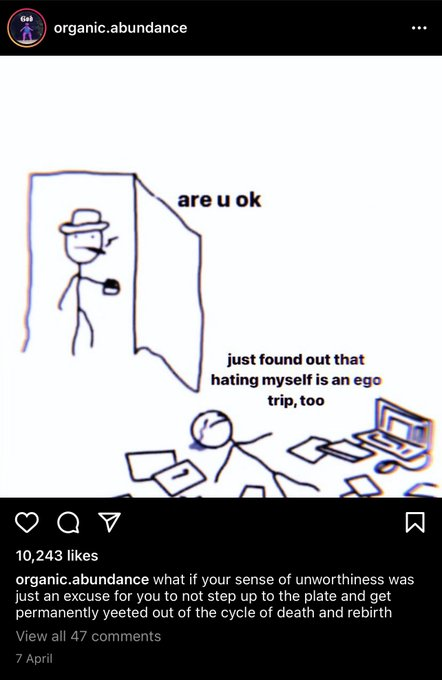
✱
few people like to admit it but this is a form of narcissism
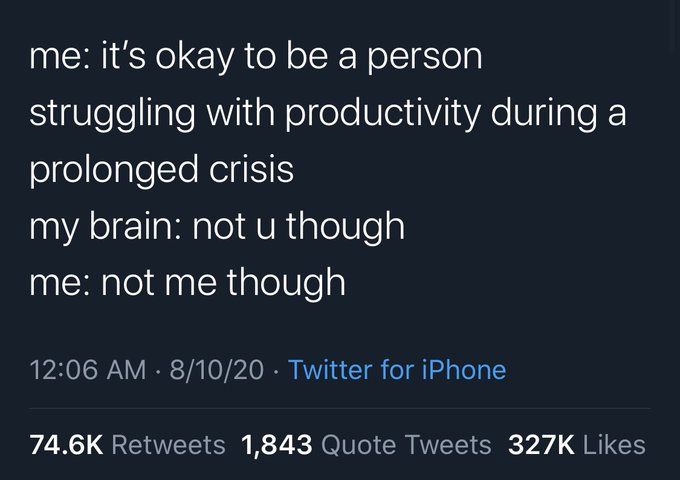
the question to ask, with kindness, is: what makes it different for you vs everybody else?
(Two Popes spiritual pride)
this sort of thing is seldom conscious. it’s often a kind of unconsciously internalized language of coercion. you could see it as a defense mechanism. the superego is trying to protect the individual (and whoever else might suffer from their failures) by admonishing them
the trap to avoid – and it’s quite funny, and it’s good to laugh about this – is to avoid beating yourself up for beating yourself up. it will be hard to unlearn this habit, but it *can* be unlearned with practice and reflection
part of why it’s easy to sympathise with OP is that lots of people do feel like they have little to no control over their inner voice.
“It’s my brain being an asshole to me, and I have no choice but to suffer its abuse.”
This is tricky stuff. It can feel real + inescapable.
but the internal struggle for influence within your mind is something that you *do* have at least some influence over. the challenge is to try to approach this process with kindness and patience. it’s not easy but it’s possibly the most worthwhile thing you can do for yourself
lots of people inherit a model where they (the conscious self) are fascist authoritarians over themselves, who have to control, discipline and punish their Bad and Naughty impulses. This creates an unhealthy, dysfunctional internal relationship. A better way is possible
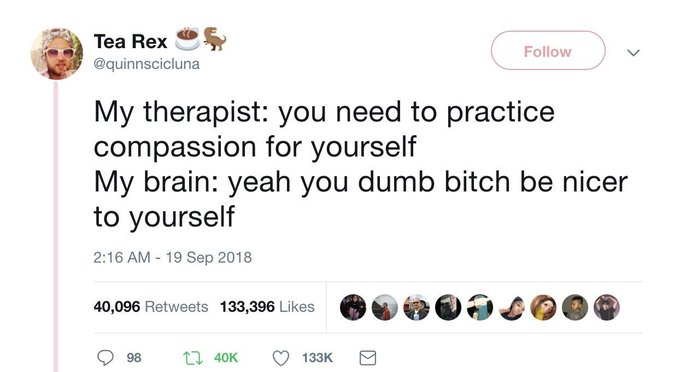
here’s a thing that I believe to be true, and has worked pretty consistently well in my experience. if you want to talk someone down from being an asshole, don’t say “stop being an asshole you fucking asshole”. instead, show them how to be a nourishing kindperson. It works better. ofc not always, and it’s definitely not always easy, especially if you’re the one on the receiving end of the torment. not fair to demand that ppl being abused be kind to their abusers. but if you have the time & headspace, and you can suss out whether the person is receptive…
(feeling a bit self-conscious for talking so much about how I’m talking — but I know that I’m objectively good at this, and have learned a whole bunch of things from extremely painful and intense trial-and-error over the years. this should be helpful to at least one other person)
✱
Been chewing on a personal formulation of how to navigate the tension between genuine self-love and ugly narcissism
How about this: I should strive to be in the top 5-10% of people who love me the most AND the top 5-10% who are most critical of me
radical candor for the self
✱
Parasitic ego
I sometimes think of narcissism as a sort of parasitic disease. The ego, originally a helpful construct, swells uncontrollably, metastasizes and seizes control of its human host. The host will then act against its own interests, damaging relationships with others to serve the ego
the mistake with trying to help a person address their narcissism is to address the narcissism head on. It’s like telling a weak king that his most trusted advisor is corrupt. You’re right, but he won’t trust you over the advisor, who warned him that that’s what you’d say
✱
Small differences
been thinking a lot about Contrapoints’ observation about cringe and the narcissism of small differences: we get most frustrated with the people who are similar enough to us that they “make us look bad”. Intimate grievances and internal conflicts are the most intense
“they make us look bad” does seem like quite a rational and genuine concern so I still don’t quite know how to feel about it. I suppose the real issue is the broader public’s impulse to generalize, but that’s far more difficult if not impossible to address meaningfully
half-joke eg: lots of people conflate me and vgr as “that brown guy whose name starts with v who tweets a lot”. As such, either of us can kinda influence the loaded assumptions that other people have of the other guy. Eg if I create stupid drama some people might think he did it
I suppose the interesting thing here is that the intensity of the conflict is a direct function of one’s frustration with facing incorrect and uncharitable assumptions. If you zoom all the way out maybe there is acceptance, a smile and a laugh. It does require an abundant spirit
a more broader eg: my twitter is a friendly nerd zone, but it’s an uphill battle to persuade non-twitter users of this bc they’re used to thinking of twitter as a hellsite. Which… ok they’re not wrong, but the situation’s a lot more nuanced than that
but if I get mad at them, that doesn’t help me in any way. the only winning move it seems is to use the emotional rush of frustration to double down on continuing to build and demonstrate what I think is best
✱
Frames reinforce themselves
in my experience, anti-cliquishness, while often well-intended, actually has a way of encouraging more cliquishness. it’s like anti-narcissism. the narcissist is just happy that you’re talking about him. every group is a kind of narcissistic superorganism
that doesn’t mean nothing can be done! something *can* be done. you can disregard the frame entirely, and focus your time and energy on what you want to see more of
suppose we’re talking an the entire generation, for eg. “I wish millennials were less narcissistic”. this just encourages people to argue about it, which REINFORCES THE FRAME.
you *can* help make a group less narcissistic. you do it by talking about literally anything else
the art of obliquely and skilfully changing the subject to steer conversations towards more fruitful directions is something I’d like to see more people get good at
you don’t have to accept a bad frame, and you don’t have to loudly denounce it, either. you can disregard it
(Editing thought: This is kind of how depression is “defeated”, in my view. You don’t accept it, you don’t denounce it, you obliquely diverge from it. That’s been my experience, at least.)
✱
Hating narcissists incentivises narcissists (who enjoy the attention and love to be hated) and disincentivizes non-narcissists (who exit because they don’t want to appear narcissistic)
“It is always the humble man who talks too much; the proud man watches himself too closely.” – G.K. Chesterton
✱
Narcissism is a bug of the mind.
It’s an optical-temporal illusion, a fixation on the narrow image of a self that doesn’t actually exist. Call it ego if you like. It’s mistaking the menu for the meal, the map for the territory. There is no self, we are all waves in the ocean
✱
Anti-narcissism
Respect other people’s autonomy and boundaries. Nobody owes you their time, attention, kindness
Apologize for your mistakes.
Be patient and kind. It’s not about you.
Negative interactions are not personal attacks. The self is an illusion, nobody knows you well enough to really attack you personally
There’s nothing to be ashamed about. It’s okay to fail. It’s okay to make mistakes. It’s okay to be imperfect.
Forgive others for their mistakes. Do this privately, internally, don’t make a show of it.
Give people space to complain, grieve, be upset, angry, etc.
Accept people’s right to disagree with you.
Seek win-win outcomes. Aim to give more than you receive.
Don’t get defensive.
Support others
✱
Report on your own experience
sometimes people feel compelled to comment on something but feel anxious about being unqualified, “it’s not their place”, etc
the way to approach this IMO is to make yourself the subject of your commentary. eg, rather than say “X is like Y”, report on your own experience of X
this is something that’s kind of obvious to me after like 20 years of experimenting with different forms of commentary
“What Is Wrong With X, says Y Guy” – gonna be bad
“Y Guy shares experiences of Y” – much likelier to be reeived warmly
it’s a lot about framing, sensitivity
some people think, “oh gosh, but I’m just some random person, isn’t it kinda narcissistic to talk about myself” – I would say the opposite, actually. whether or not it’s narcissistic depends not on the subject, but how you frame it, and how you invite readers/viewers to engage
there’s some small % of people who will interpret ~any~ sort of self-reporting to be *intrinsically* narcissistic, but if you make a deliberate effort to be making a gift of your thoughts, experiences, perspectives, those people are easier to brush off. esp when others thank you
“narcissism” is a convoluted word and I don’t like to use it, but I’d say that creating the illusion of objectivity by talking about generalizations WITHOUT articulating your own biases, context, etc, is actually more selfish and presumptuous
there are exceptions to this ofc
another maybe somewhat surprising/unintuitive thing – not only is this worth doing for it’s own sake, it also has a way of helping you make your social graph stronger, healthier, more humane
circling back around I think it’s interesting that
1. A lot of people think we live in a narcissistic, self-obsessed society
2. I feel like we have a shortage of humanizing, personal stories
It might seem like a contradiction but I don’t think it is
uncertainty might be one way of explaining the difference
one way of defining narcissism is: a needy fixation on one’s static image of oneself, demanding others validate that self-image or else
whereas what I’m looking for is more dynamic, self-reflexive, self-questioning
so less “muahaha gaze upon my success and weep you suckers” and more “here’s what I tried, here’s what I learned, here’s what surprised me”
but of course it gets tricky bc the former group has learned to mimic the latter’s style and affectations…