2023 update: feel like doing a little bit of metacommentary on this post. It’s interesting because I started piecing it together in the 2010s and now we’re soon approaching 2025, and it doesn’t yet quite feel like we have the solution. Things like ChatGPT, large language models etc seem quite promising. We’ll see.
✱
TL;DR: In the broadest sense, we already have powerful engines; to go faster we need better shock absorbers and handling.
____
Observation: I get a little frustrated when I encounter people who fixate on flying cars, hoverboards and jetpacks. I think it’s because it feels to me like they misunderstand how things actually work and play out.
I think futuristic personal mobility devices were a simplistic extrapolation of the motorcycles and open highways. We just sprinkled future-dust on the outdated mental models we inherited (rather than think from first principles). We don’t often challenge ourselves to think about how things would be fundamentally different.
So I think the real question we should [1] be asking is… what are we currently encumbered by, and what would freedom from that look like?
I think the problem is information overload. We don’t really need to “go” anywhere anymore, at least not the way we used to. We’re now everywhere, all the time. It’s instantaneous and overwhelming.
The hoverboards and jetpacks of 2020 should help us navigate information swiftly, contextualize everything we want. We’re already racing at breakneck speed, and we’re getting vertigo, motion sickness, etc. We can individually choose to take breaks and slow down, but it’s improbable that we’d collectively make that decision. [2] So we need to learn to adapt better to the speed.
The idea that we need shock absorbers and suspension rather than a faster engine sounds a little unsexy [3], but maybe our mental models of what sexy is could use a little revision, too.
___
[1] The “should” here is based on the assumption that we want to be serious in thinking about progress and development. I’m happy to make that assumption. We can disagree about what progress looks like and how it should play out, but we should be able to agree that progress requires good questions and rigorous thinking.
[2] One interesting challenge that’s being facilitated by instantaneous connectivity is that we MIGHT be able to make such decisions. Maybe. It’s worth exploring.
[3] Come to think of it, shock absorbers and suspension will actually help us move faster than adding more horsepower to the engine. Conversations and explorations get derailed unnecessarily bevause people don’t know how to navigate conflict effectively. So the prospect of those boring things are still exciting because they enable us to navigate better. Which was the original premise! Born to be wild~~~
✱
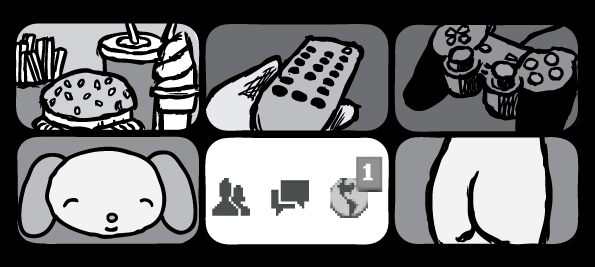
Supernormal stimuli
I was on the train a while ago without my phone (left it at home) and I was just curiously watching what other people were up to. I noticed a lady who kept switching between Facebook and Instagram over and over again. I’m sure to her it was just a mindless activity to occupy herself during a boring commute, so I don’t mean to imply anything negative about her by talking about this. We all do whatever it takes to get by. But it struck me that that behavior was awfully similar to a moth flying into a flame. We get trapped in these strange cycles because of the power of Supernormal Stimuli.
Here’s one of my favorite comics about the subject: Supernormal Stimuli
HN Discussion – Is Facebook a Structural Threat to Free Society?
✱
people seem unserious about their info diets
TL;DR: “Every new piece of news is seriously important” => fundamentally unserious about the nature of importance / priorities => suboptimal information diet => wasted cognition => frustrate => sads
_____
Several years ago I read a book that punched me in the brain in quite a few places– it was ‘More Sex Is Safer Sex: The Unconventional Wisdom Of Economics’, by Steven Landsburg.
I didn’t agree with every single thing he said, but he got me thinking and questioning a lot of things that I had taken for granted. A sentence that has stuck with me for a decade was “Any policy who won’t do this kind of arithmetic is fundamentally unserious about policy.” He was talking about the cost-benefit analysis of using capital punishment as a deterrence, and pointing out that if we were sincere about it actually being a deterrence, we’d execute computer hackers. (It’s an enlightening thought experiment.)
Here’s an excerpt of the sort of uncomfortable things he was willing to talk about:
“When we say that a human life is worth $10 million, we mean nothing more or less than this: A typical person, faced with a 1–in-10-million chance of death, seems to be willing to pay about a dollar to eliminate that risk. We know this not from theory but from observation—by looking, for example, at the size of the pay cuts people are willing to take to move into safer jobs. On this basis, Harvard professor Kip Viscusi estimates the value of a life at $4.5 million overall, $7 million for a blue-collar male and $8.5 million for a blue collar female. (Viscusi acknowledges that it’s puzzling for a blue-collar life to be worth more than a white-collar life, but that’s what the data show.)”
His point, as I interpret it, was this– if we’re serious about making the world a better place for everyone, we have to be serious about doing the cost-benefit analysis of things that make us uncomfortable. That includes things like deciding whether to use limited $$ to pay for food or for ventilators. You can’t say “Oh, we can’t put a price on a human life”. Yes you can. You can buy a child for a couple of hundred dollars. It’s just uncomfortable to think about, uncomfortable to talk about. Reality is an uncomfortable thing.
Why am I bringing this up now? I guess I’m just frustrated with my social media feed. It feels like people are fundamentally unserious about their information diets. Am I serious about mine? I’d like to think that I try to be. It’s not a contest, of course. Everybody is free to do as they please, to share what they like, and we don’t need to be uptight and rigorous all the time. There’s room for humor and amusement and all that good stuff.
In fact, I love fun, unserious stuff. What frustrates me is when people posture and pretend to be serious about things that they’re not actually serious about. Because then you don’t actually know how seriously to take people. You can’t walk around pretending that everything is your top priority, that’s not how prioritization works. The people themselves aren’t necessarily to blame (and blame is a tricky, tedious thing)– they can have good intentions. But it gets wearying.
I don’t expect to change the world or change how people post. And I’m not saying we should all necessarily start being super strict about everything we post (… that’s a pretty good idea, though, and we’d all be better off for it). Whenever I put this sort of thing out there I’m mainly curious to see who else feels similarly. Maybe we could have better conversations.
2023 substack post: Are you serious?
Filters
(2024nov comment: maybe this whole post is really about filters, actually.)
(2021 Nov 01)
I’m increasingly interested in the techniques that highly-public individuals use to maintain their sanity without compromising their intellectual rigor. Most people don’t think about this. Imagine if you had 1000x more correspondence, notifications, etc than you currently do.
The short, “simple” answer is obviously “better filters”, but how exactly do you implement them, test them, trust them, etc? This must be especially challenging for CEOs of large + high-profile companies, and they are surely interested in getting it right.
I think one relatively smart solution (for twitter) is to handpick the best proxies you can find and then have them in a private alt. So you could have 1m followers on main, and a trusted counsel of ~1,000 on alt. roughly the best of both worlds for not too much extra effort.
Most people who seek fame or have it thrust upon them don’t think too much about this before it happens, and don’t prepare for the worst, and so it either drives them stupid or insane. It’s fascinating to me. Happens to Very Smart people too.
I think as social creatures we use peers as proxies and guides for calibrating our ethics, sense of well-being, etc… and this works in “ordinary” contexts, but when you’re *flooded* with fanboys and haters, you have to rearchitect your psychology/dashboard or you go mad.
I think this might be a long winded way for me to say, prioritization can be difficult, scary and uncomfortable, but it has to be done thoughtfully, intelligently, even compassionately – or you’re handing over the reins of your attention to the worst actors. Which is yikes.
And if you think about it, this is true for everyone, not just celebrities and CEOs. We are all being flooded with information and we all have to make decisions. I remember what it was like to have 0 faith in my own judgement – but I have even less faith in the herd. -10 faith.
And now we have very clear evidence that the media we consume is absolutely manipulated and optimised for outrage, to get clicks, to get reactions, to get ad revenue. It was always true (xkcd 1227) but I think it’s clearly truer than ever.
A slightly funny thought: to participate in surfing the hypermedia megawaves, IMO you have to yourself become a grounded person. You are going to face high-voltage shocks and you have to ground them. You have to resolve your traumas and learn to “laugh” in the face of abuse. But laughter, if you’re not careful, can become an escapist coping mechanism!! Do you see what I’m talking about?? You don’t want to *dismiss* or *downplay* abuse. It’s abuse!! But you don’t want abuse to paralyze you. But you can’t pretend it’s not real! And it’ll keep coming!
How to be zen-calm in unyielding chaos while not bullshitting or lying to yourself? To take it seriously but not too seriously? (ayy lmao). It’s really a knife-edge balance and eventually everyone fails at it one way or the other (and you want to fail gracefully too if you can!)
Having written this I find myself reaching a position of just, lol. Lol that anybody pretends this is a solvable problem. I mean, maybe. But most of us are obviously gonna fail at this, & so many of us are so needlessly cruel to each other for failing at an impossible task.
Still, onward.