contending with cyberspace
Frame Studies · Internet Culture · 2025 · 2k words
How the internet affects people differently: one man's meat is another's poison. Scissor statements split audiences, cyberspace is a psychedelic trip without warning labels, and we must find ways to surf the chaos rather than be overwhelmed. No simple answers, but being oblique helps.
contending with cyberspace
we do not experience the same reality, cyberspace is a crashing of disparate realities
The following Post started out as a twitter thread in Oct2024 and I developed it further with additional details and context and freestyle thoughts and so on. I suspect I will be doing several more of these, because they’re easier for me to do than working from scratch, and they allow me to tie up some loose ends. As always, I wish I could’ve spent more time on this post, but I am a tired dad and so this is what you get, lol.
one man’s meat is another man’s poison
I recently connected a few dots that I’ve been simmering on for years now, and here it is in an oversimplified sentence: one of the reasons there aren’t “simple solutions to everybody’s human problems” is, that what sets off a cascade of insight for someone at one tier of wretchedness1 can worsen things for someone below. Or more simply, one man’s meat is another man’s poison. I know I’m re-deriving a cliché here, but I think there is useful nuance to get into about what exactly makes something nourishing, hazardous to someone else.
The recent prevalence of the phrase “skill issue” is a useful example to gesture at. It’s a scissor2 that can cleave a previously nebulous group into camps of people who feel energized and people who feel demoralized by it. Some people think, whoa, I just need to practice and I’ll get better at it! Other people think, I do not possess what is required to get better, I am irredeemably incompetent and incapable, and all this can-do attitude just makes me want to yeet myself out the window.
We do not experience the same reality, for we each experience it through different filters and frames.

For private individuals living their lives, the scissor can be kind of a good thing. -ish. mostly. sorta. In your own personal life, you want to be at least mildly polarizing enough that the social reality around you rearranges itself to suit you. Also, the deeper truth is that we can’t escape or avoid this. It’s always happening! The attempt to avoid being polarizing is its own kind of polarizing; it’s just less obvious or visible because the people you’ve put off are less likely to say anything to you. (plane-dots.jpg)
can’t we help some without hurting others?
Framed another way (and this itself is a somewhat wretched framing that i don’t love): You cant help people without ‘hurting’ the people who are unable to receive that help, in the sense that you’re reminding them how wretched they are. I’m not a big fan of this framing because if you’re not careful it’s very easy to justify inaction. And… I think with the exception of some extreme cases, most people could probably use a little more action, even if it means upsetting some other people.
But it really depends on what you’re doing and what you’re talking about. Some contexts merit far more caution than others, and generalizing here is unwise. But in a context like Twitter, for example, I would argue that… the potential upside of making a lasting positive difference to someone is worth the risk of annoying even several other people. Internet annoyance tends to be fleeting, even if only because the people who tend to get annoyed by scrolling tend to find something else that annoys them pretty quickly.
I don’t think it’s likely that we’ll arrive at a healthy public internet commons by having everyone police themselves and each other to minimize offence. I think we have already seen a collective understanding of this emerge, though as collectives often do, it may also already be racing way too quickly to the other extreme. I do think it’s worth encouraging people to be considerate, and if you follow me you’d notice I’ve spent quite a lot of time and energy doing exactly that. It’s nuanced stuff that’s hard to condense into anything succinct. Sometimes I think we can only really demonstrate over time what we really mean. This is a process that will involve trial-and-error and misunderstandings, because of the nature of communication.

For that process to play out, we cannot punish innocent errors too severely. Though the question then arises, how do we know which errors are innocent? And what’s to stop abusers from feigning innocence when they have malicious intent? Every turn we take, we run into more complications. And yet the task ahead requires that we do not quit, and in fact somehow find a way to be cheerful and upbeat as we pursue an impossible quest.
Here too, framing is part of the solution: all we can really do is the best we can, where we are with what we have. All we can do is run our leg of the race well and pass the baton on to the next kid. That’s how humanity has chugged along for generations. None of us is obliged to solve all the problems in the world. We just have to face what is in front of us.
meatspace vs cyberspace
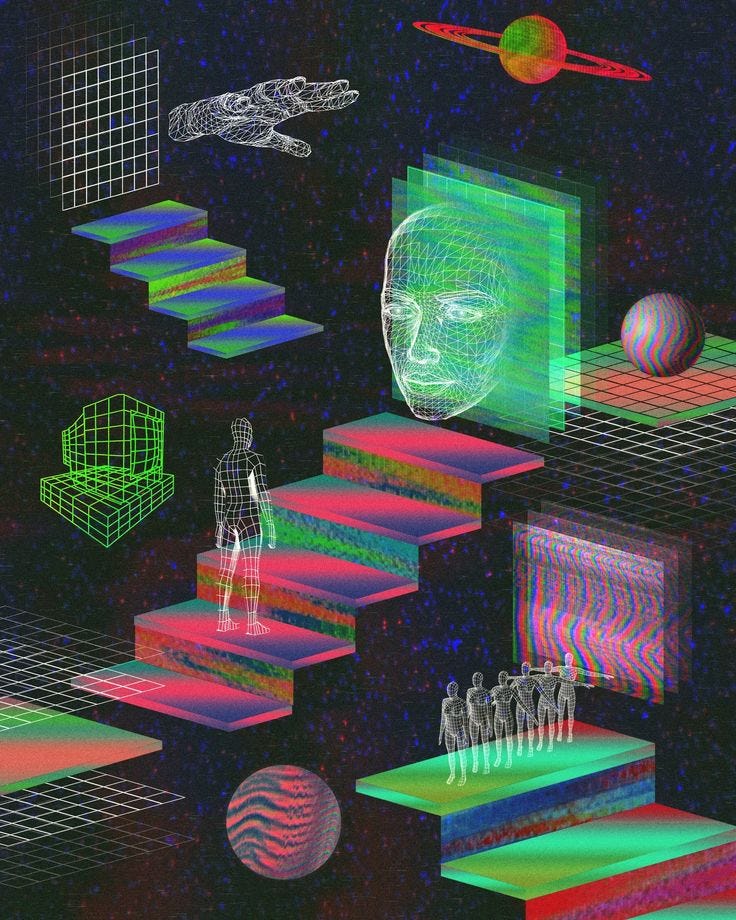
In the physical world, all of this mostly “shakes out” via an emergent hierarchical ordering. If you wanna get nerdy about the details, it doesn’t necessarily need to be vertical, or the verticality can be along multiple dimensions. There’s a rich part of town, there’s a fashionable part of town, and so on. People end up hanging out with others in similar conditions, with similar inclinations, and this creates safety, familiarity. People merge with a slice of society that matches their psyche.
I don’t think many people do this in a very conscientious way– mostly we simply gravitate towards our people. I think kids do this from a very young age. It’s so wild to look back on my own childhood and notice how many of my friends (and even my ‘enemies’) were people who had similar interests, similar inclinations, similar ‘psychographic profiles’. My people were typically nerdy, curious, hyperverbal, passionate, averse to ‘the norm’. We all seemed to find each other quite effortlessly, congregating at the back of the classrooms, at the music gigs and so on. And so, very naturally, people cluster and congregate into cliques. For more insight on this I recommend watching the classic sociological text Mean Girls (2004).3
the babelfish problem
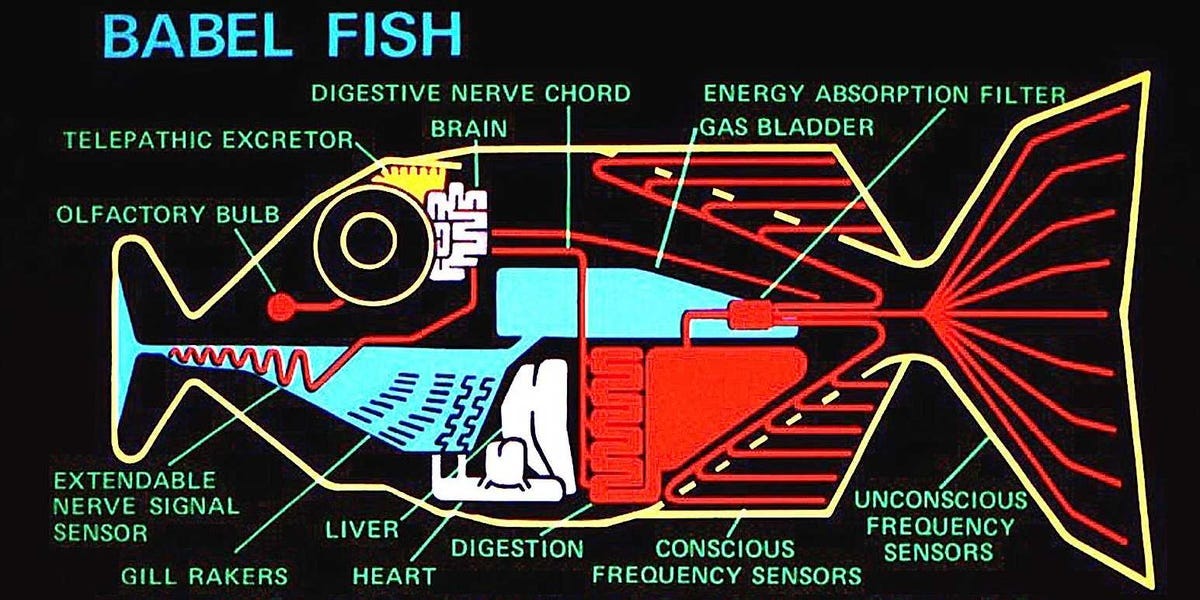
A major challenge of the digital age is something akin to Douglas Adams’ Babelfish problem. The removal of barriers to communication across social silos has created conditions for a kind of ““psychosis”” that unpracticed/untrained minds can really suffer from.
I’ll describe a somewhat silly form of this that should be intuitive: we were never really meant to see so many super attractive people.
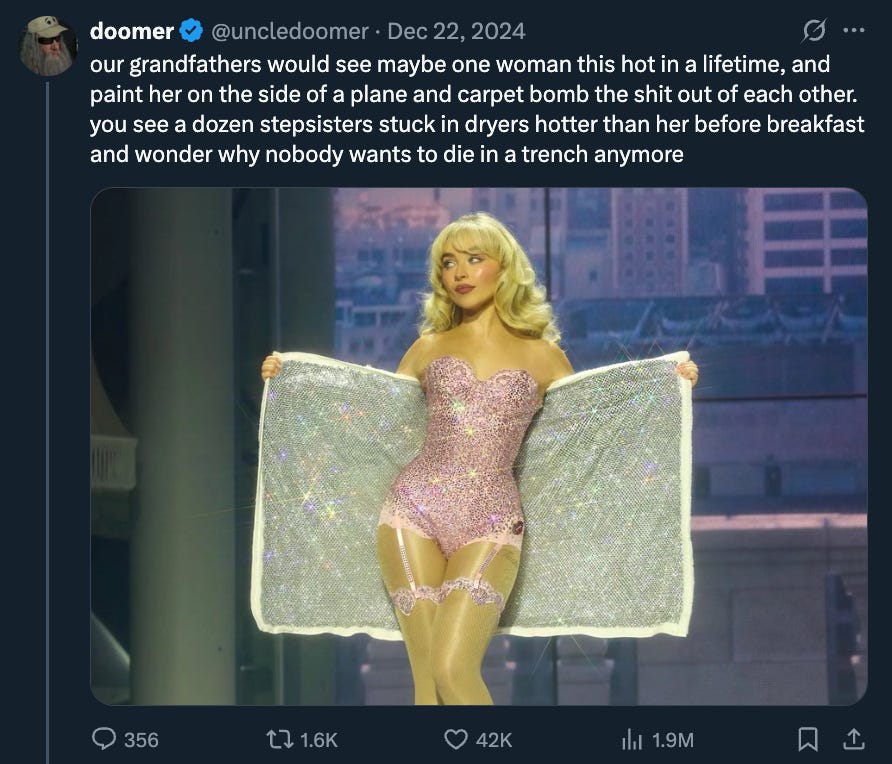
Think about someone joking “i saw a girl so hot it ruined my day”. If you heard it from a friend, you’d probably assume they were half-joking, being hyperbolic, but you could also see how there would be some truth to it. The attractive person reminded them of their own desires, or their own inadequacies, things which they might feel are beyond their control. But now imagine someone who’s mentally and emotionally unwell, saying this, following them on IG and actually getting really worryingly fucked up about it. (this splits into “young girl who develops body image issues” and “guy becomes misogynistic turbo simp gooner” patterns. of course there are many other things going on here…)
not all are one-shotted equally
but the point im trying to explore/develop here is mainly the gradient of how different people are different levels of susceptible to experiencing psychic damage from any given stimuli. If that sounds similar to people talking about drugs, well, it is!! Joseph Campbell had a great riff about this, talking about how the LSD experience and the yogic experience are both a kind of intentionally achieved schizophrenic psychosis. Everyone plunges into the same inward sea, the question is whether or not someone is capable of surfing the waves of chaos, or are they pulled beneath them.
Simply having a smartphone that’s connected to the global human network is analogous to actual psychedelic trip; it’s just so commonplace now that we think of it as ordinary. I would actually argue that smartphones are wilder than drugs, because at least with drugs it should be moderately obvious, hopefully, that whatever hallucinations you’re experiencing are temporary and contextual. Smartphones, on the other hand, also present us with a funhouse kaleidoscope of reality without any warning labels.
we are living through a digital reformation
It really is very much a kind of ongoing revolution-slash-reformation4 that we’re all living through. our institutions etc are still struggling to adapt. there’s ~always a human cost to progress that we should be mindful of (and i say this as an incorrigible optimist!!) It’s hard to make big predictions about how such a dynamic thing will play out on the large scale. Probably it’ll get both better and worse in different ways. I think some of the most chaotic elements mayyy be reined in or contained, more via naturally-emerging human consensus than anything else. And/but who tf knows how AIs and LLMs are gonna accelerate things?
I always try to bring things back to people. How are people doing? What are they dealing with? It can be relieving and amusing to discover that people in the 1800s were already complaining about the dizzying pace of modernity and information overload etc. But multiple things can be true– it can be true that the present moment has always felt dizzying, and it can also be true that some future moment will cross some threshold of human capacity– much like how the Roman empire must’ve always seemed to some observers like it was in decline, until one day it really was no more.
chaos-surfing requires nimbleness
One intuition I have, that might take me a while to develop, is that the winning strategy to approach all of this– the way to surf the waves of chaos– is to be somewhat oblique. As Emily Dickinson said, tell the truth but tell it slant. I’ll explore this in greater detail in later posts. I’ll leave you with this, which might seem sorta unrelated, but I think it’s very related.
The question becomes something like, how do we design gentle gradients in cyberspace, which is a hypertext domain that smushes together space and time into a big jagged janky hypercube? Is it fundamentally impossible? Or are there possibilities we haven’t considered yet?
✱
See also:
An old concept that I intend to reintroduce and write more substantially about. I think it’s a healthier substitute to the term ‘incel’, amongst other things.
Reference to Slatestarcodex’s Sort by controversial, a fictional post in which statements called ‘scissor statements’ would divide a group of otherwise aligned people
Here’s a thread I wrote about an essay I wrote about Mean Girls back in 2014, it went pretty viral back in the day.
(I might edit this post later to expand on this reformation point, but here’s a sidethread I wrote if you want to get into it.)
Originally published at https://visakanv.substack.com/p/contending-with-cyberspace.