the min-max mystery
Frame Studies · Psychology & Emotions · 2026 · 2.1k words
Visa tries to understand why he doesn't always pursue pleasure or avoid pain, the 'inaction puzzle.' It comes down to avoidance patterns practiced unconsciously, and becoming a father has forced him to see them and choose presence instead.
the min-max mystery
I'm still dissatisfied with the pleasure principle
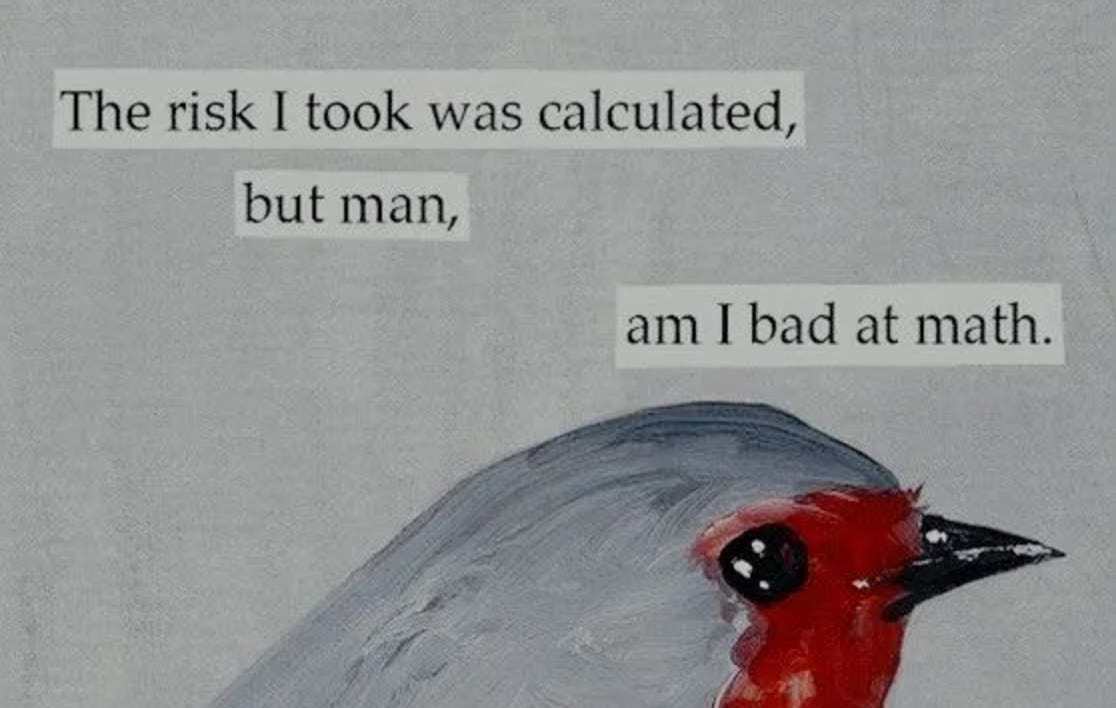
I’m going to circle again around something I tried to approach with are you having fun, son? and if it pleases you. I’m trying to make sense of my own behavior. I’m going to try to focus on my own experience so that I don’t generalize needlessly and/or wrongly.
There’s a general assumption, perpetrated by Bentham and Freud, that people are fundamentally pleasure-seeking and pain-avoiding. This seems broadly true to a first approximation, but it does not feel like it has much useful explanatory power for me. I have many examples in my life where I left seemingly “free pleasure” on the table, and I also have many examples where I neglected to avoid pain that seemed avoidable. For convenience let’s call this the min-max mystery.
So what explains my behavior? I want to understand this so I can direct my behavior better.1
One way to explain the min-max mystery is that it’s a perception problem. Which could be described as the avoidance of the discomfort of putting in the effort to really perceive what’s happening, and to consider the implications, and to follow through accordingly. In this model, I’m not perceiving that more pleasure or less pain is possible. I imagine Freud might say that I am acting in accordance with the pleasure principle within the constraints of my knowledge. “Seems” was doing a lot of the work in “seemingly free” and “seemingly avoidable”– could I actually see it at the time, or only in hindsight? This is unclear to me, and it suggests that I might benefit from some more granular journalling (which I haven’t really done properly in years.)
I asked Claude for some ideas for other names for “the min-max mystery”, and a suggestion I liked was “the inaction puzzle”. this makes it less about perception and more about action, which could mean that I do know that more pleasure or less pain is possible, but I flinch from the cost of taking action– or the perceived cost of taking action. (This does make it a perception problem again!)
I do think everyone relates to the idea that we tend to overestimate how costly it is to take action. Getting started on something can seem daunting until you actually do it. One thing I remember being struck by was how, when my son was about 1-1.5yo and learning to feed himself, he would often make a tremendous mess. Oatmeal flying everywhere, on the floor, on the walls. I remember repeatedly being dismayed at the scale of the mess, but then subsequently, while cleaning it, I would be quite startled by how quickly I was done. Why is this so counter-intuitive? I’ve asked a couple of different AIs this and their overlapping answer is basically that it looks bad, which induces dread. I suppose that’s valid, but feels incomplete to me. I think there’s also an emotional component, based on one’s past experiences with messes. Maybe if I grew up well-practiced at cleaning messes immediately, I’d have less of a negative emotional reaction to any particular mess?
✱
A phrase that came up2 for me in a recent twitter thread was, “to feel like you are living your life, you have to get to a point where your conscious choices outweigh your unconscious ones.” And the context for that was, I was talking about the pressure I was under as a kid to pretend I was okay when I was not. There was a recursive element to this– I wasn’t just pretending for other people, I was also pretending for myself. I did not want to be visibly in pain, even to myself. So I became invisible to myself. This sort of recursion creates tremendous murkiness. It made it harder for me to know what I wanted, what I cared about, when I was tired, and so on. And I do agree that yes, this is ultimately an example of pain avoidance. But the murkiness makes it hard to see. In trying to avoid pain, I ended up causing myself more pain. But since I was in denial about the fact that I was avoiding pain in the first place, I could not do the simple-obvious thing and simply cease the acts of avoidance. What acts? I could not do a simple straightforward scan of “how am I avoiding pain?” and get a good answer, because the evidence was hidden even from myself. It doesn’t show up. Avoidance is tricky like that.

And looking back over my life, it seems clear to me that I always underestimated the costs of avoidance. I always pretended that avoidance wasn’t a thing I was doing.
I think that’s one of the biggest breakthroughs I’ve had. That deferring is an act, it is something I do, and something I got very good at doing, to the point where I started doing it unconsciously. I refused to see it then, but over the past year or so it’s become very difficult to unsee.
✱
What am I really trying to do here? Am I trying to be happier? More productive? The most important thing for me right now is to take care of my family, which means both providing for them and being present for them. A past version of myself saw these two things as being in competition with each other– that time spent being present is time not spent providing, and vice versa. And that’s sort of true in a limited sense, but… there’s a lot more going on. It’s unlikely that I’m anywhere close to efficient, and I also do believe that the possibility frontier can be extended.
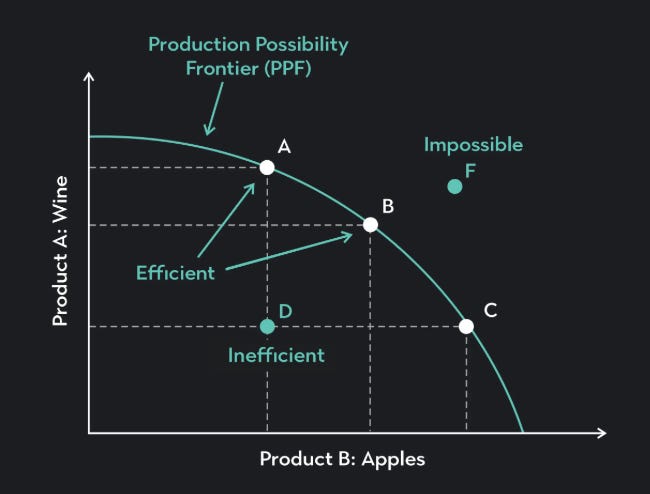
So yea, I believe there are inefficiencies in my presence and in my provision. And I suspect they are in a sort of yin-yang strange loop. Being more present with my family should give me the emotional fortitude I need to confront the challenges I face as a provider. Getting better at providing should give me more breathing room to be present without being anxious. But here I’m reminded of the wretched spiral I’ve been stuck in before:
I fixate on trying to provide more
I struggle and fail at it
I feel guilt and shame about the failure
The shame constricts me into feeling unworthy and/or incapable of presence
Lack of presence makes me more anxious, despairing
I resort to various unhealthy coping mechanisms with a cover story of “this will distract me from the pain and then I can provide more”
Fail to provide more, fail to be present, cycle keeps getting worse
The last time this spiral reached its worst, I crashed out really badly, and my wife graciously pulled me back into reality by pointing out how badly I was failing, and how selfish I was for shutting her out of it. I logged off the internet for about 6 months (anybody who knows me knows how insane that is– I used to post even when I was sick) and spent a lot of time staring at trees. I came to see that these patterns of avoidance go all the way back to my early childhood, and I also saw very clearly that if I didn’t find a way to disrupt this pattern, my wife and children were going to pay the price for it.
I’ve since made it a habit to prioritize presence and connection with my family over everything else. I see now that I was even using “I just gotta provide more” as a kind of anxious bullshit cover story to avoid the discomfort of connection, of being vulnerable, of acknowledging my failures. I suspect this must be a pattern for a lot of absent workaholic dads around the world, and witnessing a version of that pattern in myself has, annoyingly, made me feel less righteously indignant about all those shitty dads out there. There’s some of that in me too. I could be that guy. I’m trying to be different. But I could be that guy. I have been that guy in some moments. The challenge is to be different.
✱
Alright, I’m getting tired and I gotta wrap this up. It’s funny, I’ve now been sitting here long enough, got distracted a couple of times, and it starts to feel a little painful to be here. My mind is spacing out a bit, and ordinarily I think I would defer making a decision about what to do here. “There’s something there, but it’s unpolished, unfinished, clunky.” The idea of hitting publish on something like this feels moderately painful and unpleasant. But I’m currently lucid enough to remind myself that I made a commitment to try and publish regularly, I’d like to have less jank in my process. I’d like fewer unfinished drafts. So, right now I can see that it’s worth enduring a little bit of pain now for less pain later. But why don’t I see this more often? Why does this so often fade from my awareness?
It bums me out a little that I don’t have a more compelling answer than “it’s probably just a lack of practice, and a lack of a supportive context that supports the practice”. What have I practiced other than deferring things? Well, I used to write a lot, and I’m trying to write a lot again. I practiced good reply game. I practiced making friends. That’s… about it, really. What are the common features of things that I practice a lot? Does it still really boil down to “they make me feel good” or “they make me feel less bad”? Well ultimately everything does, the way everything gets burnt to ashes. The question is, what makes things feel good or bad? Meaningful things feel good, and meaning can be constructed. False assumptions and expectations can make things feel bad, and they can be interrogated. And I do believe that I can write and think my way through all of that.
A lot of my thinking about all of this has been rekindled by the reality of becoming a father. One thing I can say is that I have been sleeping better hours since having a kid. It matters to me that I make sure to send him to school on time, and that I’m alert and awake enough to be with him when I can. I’ve always been kind of a sucker for punishment in the sense that some part of me feels like I deserve anything bad that happens to me, and there was a loopiness to that that I couldn’t get out of by myself. But I don’t want to subject my kids to that, the same way I don’t want to subject them to my sleep-deprived zombie state. I don’t have the time or energy for that kind of bullshit anymore.
Rereading this, I have to laugh– I have been journalling about this for 20+ years. A lot of it must have been the wrong approach. Sometimes I give up on trying. But I do keep coming back here. I do still believe I’m going to get to the bottom of it. And if I can be a little kind to myself, I do think I’ve made a bunch of important progress that I take for granted.
I phrase it like this because sometimes when I’m writing, especially when I’m writing this sort of twitter thread, I feel like I’m barely there, I’m not even the one writing it. I’m just channelling the thoughts, ideas and insights of “something within myself that’s greater than me”. It bypasses my internal censors. This is a huge part of what I love about writing and why I feel it can be so lucrative. Because we are more than we think we are. The point is to write beyond what we think.
Originally published at https://visakanv.substack.com/p/the-min-max-mystery.