I’ve been really frustrated with the state of discourse in most fields. Most people are, in my biased opinion, caught up in discussions that are suboptimal. This happens on Facebook, sure, but also on Quora, on blogs, on Reddit, on Hacker News, everywhere.
Prioritization in discourse
We rarely start with the principle of “what’s the most important, interesting, useful and/or surprising thing we could be talking about?” I like the Give It 100 principle: Don’t bother talking about anything until you’ve done the homework, you’ve experimented enough that others can learn from your experience.
If you look around, people are mostly repeating the same thing over and over again. We discuss things like the optimal color for a Call-To-Action button, or what the best social tools are, or what time you ought to tweet people… all really relatively trivial, mundane stuff.
The real important work tends to happen in the trenches. What are those people reading. I have a feeling Steve Jobs didn’t sit around reading listicles on the Internet.
An interesting thing I’ve noted is that a lot of really successful people like to read biographies and autobiographies of other successful people. Probably because there’s less fortune cookie wisdom and more case studies to study, analyse and learn from.
You’ll learn more as an entrepreneur from reading about the lives of entrepreneurs than from listening to their victory lap speeches at university commencements.
Utilitarian approach to social media
Another thing I’ve been thinking about or developing in real time is a utilitarian approach to social media. Everybody has a slightly different approach, but I think the casual laidback thing people do on Facebook is to add familiar faces- that guy from the neighbouring class from school 8 years ago, etc. Kinda what we used to do with MSN messenger, where more contacts = more contact options. We Like a bunch of pages for all the products we use, music we listen to, etc.
What we didn’t realize when we were starting out is that we’d eventually develop a newsfeed- there wasn’t really such a thing in 07 or 08. We didn’t realize that we’d be flooded with notifications and data that might not actually be useful to us. And we sorta live with it. Similarly for Twitter I think many of us just mindlessly follow friends and celebrities, as well as social media profiles of brands we like.
All of that is fine if you plan to just be a sort of casual social media user. But I’m always craving something better when it comes to Newsfeeds, so I’ve developed a rather rigorous system.
VISA’S UTILITARIAN SOCIAL MEDIA ADVICE
#1: Avoid broadcasters.
Don’t bother following anyone or anything that posts links without @ mentioning people. Only follow people who reply to mentions- that’s how you build relationships. If you’re not either learning or building relationships, you’re wasting your time.
#2: Avoid celebrities and organisations.
Don’t bother following social media accounts of celebrities unless you’re confident of getting reciprocated, or you’re studying them for a very specific purpose. So there’s no reason for me to follow @whitehouse or @barackobama unless I’m planning to study the nuances of how they post.
If you follow the right people, you’ll still see news from CNN, etc retweeted on your feed.You didn’t need to follow Ellen to see a picture of the Oscar selfie. If something is important enough and you’re following quality individuals, the news will get to you anyway.
An exception for me- I follow ST’s Foreign Desk because they share genuinely interesting news that gives me a lot of context on global issues. Regular Straits Times news is generally uninteresting and I don’t need it. When it’s interesting, I’ll see it in my feed.
#3: Follow thoughtful people in your industry who’ll actually talk to you.
This is part of a lengthy process that earns you credibility if you have anything useful to say. This is digital networking. Don’t sell your shit, just focus on adding value to conversations. If you don’t know how to do that, get off social media and go do some reading. Quora is a great place to practice. Trial and error until you start getting answers with hundreds of upvotes.
Reddit is a pretty good place to practice, too. Go into any subreddit of your interest and study the /top and /gilded threads and reverse engineer what works. As a general rule, you either gotta be really witty, really entertaining or really useful- or some combination of the three.
In almost every case you’ll see people going the extra mile. That’s what gets rewarded. Some lawyer enters a thread and gives a well-researched answer that expands the mind of others. Etc. Give people information they wanted but didn’t have, or present the information they already have in a more elegant way.
#4: Post nice replies to anything personal.
Someone posts something about an anniversary, birthday, funeral, or even just how tired they are? Go in, be nice, be supportive. They’ll associate you with positive emotions. Insert cheesy quote about how people don’t remember what you said or did, but they’ll always remember how you made them feel.
#5: Bring something to the table.
Some people have massive audiences and get tonnes of responses. Justin Bieber, for instance. Millions of teenage girls think they can get Justin to follow them just because they posted something on his wall. That’s a losing game. If you want to get to Justin, you have to find out what he wants/needs, and who his managers and gatekeepers are.
If you want an investor to invest in your startup, it’s really bad form to approach them directly. So bad, in fact, that many (most?) investors use that as a shit test to weed out the amateurs. If you’re really an entrepreneur, you’ll find a way to get an introduction.
Plot out a map of relationships between yourself and the person you want to reach. It’ll take at most 7 steps, and honestly it’s more likely to be 3-5. Of course, even that is the easy part. Suppose I’m 4 steps from Elon Musk. (Actually, 1- the ex head of hiring at SpaceX is following me on Twitter.)
Despite this “easy entry point”, it would be disrespectful for me to approach her to set up an introduction if I have nothing meaningful to say. That’s how relationships work. I would only introduce you to someone else if you convince me that the introduction will benefit my friend and make me look good in the process- otherwise you’re begging, and those social situations are awkward and sad.
I think Elon Musk described once how Larry Page introduced him to Steve Jobs at a party, but he had nothing meaningful to say so that was that. A party is a nice/neutral space for random introductions, but still the point is- you have to bring something to the table.
#6: Have a blog.
If you’re connected to the Web in any way and you plan to make a living off of it, and you don’t have a blog, I personally think you’re an idiot. I’m sorry, I do. Exceptions can be make if you’re really famous or prolific already, or you’re working on something really notable- my boss doesn’t need a blog because he’s running a startup, so in a sense the startup is his blog. But if you’re a nobody like me, start a blog.
I got employed because of my blog; I have neither a degree nor a resume. My blog is my resume. Think about it, resumes (and academic papers, but that’s another story) are highly outdated, designed for an era with gated distribution. Why send a resume to 100 people when you can have a blog that brings you 100,000++ hits? A blog allows people to discover you at their own time and pace, searching for what they care about. You no longer have to constrain yourself to a resueme’s limitations.
Your employers are probably going to Google you. What do you get when your full name is Googled? A blog allows you control over that narrative. I’ve done business over Twitter, I’ve sold tshirts over Facebook. Digital real estate is a very real thing, it’s easily accessible, if you don’t have a blog you’re dramatically missing out on the best way to establish yourself internationally. Search means that stuff you wrote in the past has a chance of blowing up (in a good way) in the future.
If you’re a nobody, blogging is a really good way to become a somebody. Just write passionately about the things you care about.
6: Hide/unfollow anybody who posts toxic rubbish.
The heuristic I’d use is- imagine you’re your own personal assistant. What would you flag for your attention? Does this information enrich your life? No? Then it’s meaningless noise- which isn’t just a waste of time, it’s a waste of your mental bandwidth. Time arguing with internet trolls is time not spent building something. Of course, some argument can be good practice, but it’s very easy to fall into the trap of fighting for the sake of fighting. Life is short and your resources are limited, so pick your battles carefully.
#7: Be as useful as possible.
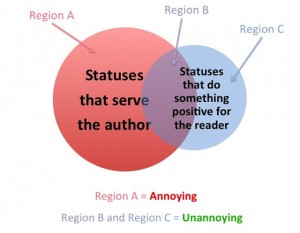
This is from WaitButWhy.com’s 7 ways to be insufferable on Facebook. The image links to the post.
It’s tempting to fall in love with your own voice and start tweeting/posting inane bullshit, but this is a noisy thing that people get tired of. If you want to create value in the social media space, a good starting point is “always be useful.” That can mean posting funny/entertaining/thought-provoking stuff. But make sure you have in mind how your post (s) are going to be interpreted. This is relatively trivial to fix. Mostly it just means giving a quick look at anything you’re going to post, and ask “Am I stroking my own genitals with this one?”
#8: Don’t link to anything you can’t defend or explain.
Buffer has a bunch of suggestions for generic links and quotes, and while I’m sure they’re well-intentioned, I personally find it rather annoying and noisy. I don’t care about what Abraham Lincoln said; if I wanted to know I’d follow an Abraham Lincoln novelty account. Maybe this is unique to power users like me who aren’t interested in discovering shit that I’ve already heard a thousand times over.
Same for links about the optimal times to post a blogpost. That’s like rearranging deckchairs on the titanic. The only really important question is- how do I post content that actually expands people’s minds? Build a reputation for posting especially good quality stuff; it’ll serve you well.
The danger of sharing superficial stuff is that superficial folk will favorite and retweet it, and it’ll look like you’re “making progress”. This is deceptive and dangerous if you’re serious about creating long term value. I suppose it’s not necessarily wrong, but the litmus test for me is the crowd you attract. I find opportunity folk to be a bit sleazy and I just don’t enjoy the conversations that I have with them. Your mileage may vary.
If nothing else, read WaitButWhy’s 7 ways to be insufferable on Facebook, and avoid doing all of that.