VVM The Visakanv Megaweb The Visakanv Megaweb

Welcome to theVisakanv Megaweb

Since 2008, Visa has been thinking out loud on the internet, sharing his ideas with the world. The result: a quarter-million tweets, more than a thousand essays and blog posts, and hundreds of videos. The Visakanv Megaweb collects all of it, plus the books and media Visa keeps recommending, into one archive, organized so you can find your way through. Pick a place to start.

262K
tweets
1,251
essays & blogs
459
videos

An archive of Twitter postsby Visakan Veerasamy

Visakan Veerasamy (@visakanv) has been posting on X (formerly Twitter) since 2008, racking up more than a quarter-million posts across dozens of topics. The Visakanv Megaweb organizes them into a single archive you can browse without friction. Explore Visa’s most popular posts, favorite themes, and online network via curated lists. Looking for something specific, or want to browse the archive your way? It’s all here: filters for date, length, and more, plus search across text and handles.

262K
tweets
26K+
threads
36
themes

0804: introspect: overview

One Million Words · Self-Knowledge · 2021 · 1.2k words

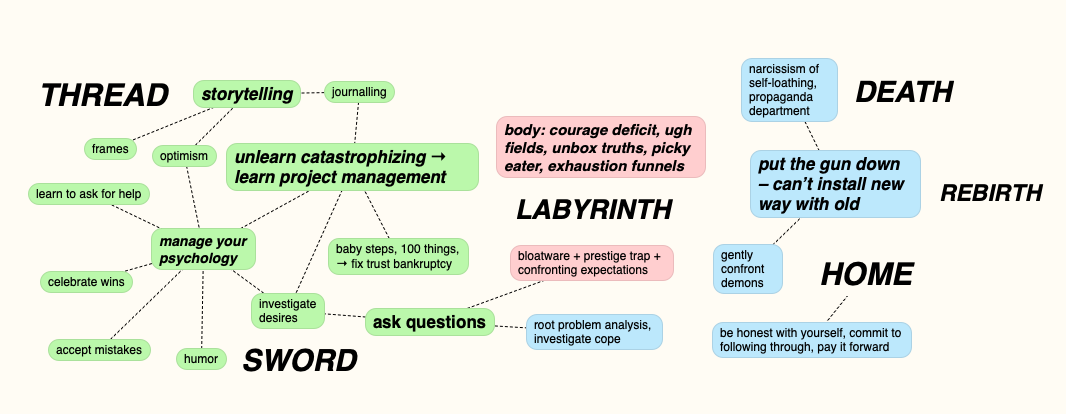
Visa outlines his book INTROSPECT as a hero's journey: leaving home, facing oneself in the labyrinth, and returning transformed. The thread is storytelling and continuity. He wrestles with fear, project management, and the tedium of growth.

0804 – introspect: overview

The above image is a screenshot of my latest (and final, I think) conceptualisation or overview of INTROSPECT. It’s been through many, many iterations, which I may someday get around to piecing together. But for the time being, my focus is on finishing the book, and to do that I think it would help to also use my auxiliary efforts (wordvomits, YouTube videos, etc) to talk about the book.

So let’s do an overview. INTROSPECT follows the traditional hero’s journey structure. It’s an old, familiar structure that works. Why reinvent the wheel of samsara? (This thought led me to some interesting places that will probably not be making it into this draft of the book, particularly about the solar plexus… anyway)

So. Yes. The hero’s journey, the monomyth, popularised by Joseph Campbell. It’s a cycle that starts from the place of innocence and ignorance, home. And then you’re cast out of that sanitized bubble reality, and you discover that the world is much bigger, scarier, wilder than you had initially thought. And you’re lost, anxious, overwhelmed. But you can’t quite go back home the way you came, that path is now closed off to you. So the only way is forward. But it’s a cycle. You’ll eventually find your way back home through another route. It’s a perilous path, fraught with dangerous challenges.

There are many classic tropes in the typical hero’s journey. You’re supposed to receive aid from a wise mentor figure. For me I tend to think not of a specific individual, but of books and music – though my ex-boss did play a very pivotal role for me along the way. There’s this idea of a “belly of the whale”, the “dark night of the soul”, a point of total despair and annihilation through which the hero must pass. And there’s also this sense that, out in the harsh desert, or deep in the unforgiving jungle, out in the open sea – in the labyrinth, what the hero must truly confront is himself. His own fears, anxieties. His heart. And here all meaning collapses, all hope seems to be lost. But then there is renewal. There is a light, however small. In the midst of winter, an invincible summer. And from this – let there be light – all is reanimated anew. And it is in this that the hero finds his courage, his inner strength, the voice within, and it bursts forth from his heart. And this is the nectar of the gods that he brings with him back home to his village.

Alright? That’s the basic structure. Now let’s talk details. In the story of the Theseus and the Minotaur, our hero Theseus needs a thread (gifted to him by Ariadne) to navigate the labyrinth without getting lost. (There’s some interesting complication here, where the classical labyrinth technically only has one path, so there’s no way to ~actually~ get lost, but we are looking for symbolic truths here, not practical-literal ones). My reading is, the thread is about continuity. The thread is storytelling, the thread is ancestors. The thread is a reminder that you are not alone, that even when you are physically isolated and adrift, you are not spiritually so. All of humanity’s heroes and adventurers are with you on your voyage, you carry them with you in your heart, your mind, the very language that you use to make sense of reality, and of your challenges.

There’s a funny thing here that’s a bit disjoint where I find myself saying, “the hero is a project manager”, or “the hero must learn project management”. In a way, Theseus had it “easy” because all he had to do was go into the labyrinth, confront the Minotaur (which I choose to read here as a metaphor for the ugly, angry, tyrannical parts of ourselves), and there’s one showdown and that’s it. That’s the convenient elegance of stories. Everyday life is quite a bit more tedious than that. We have to face our Minotaurs repeatedly, and it gets easier in some ways, but in some ways it never does. (Stories do capture some of this essence, when you see that even “wise elder” type characters who also struggle, often with their cynicism, which comes from years of unpleasant and unhappy experience, lots of disappointments. It isn’t a one-and-done thing.)

The project management part is also often kind of rushed through in a “training montage” type scene. The reality of heroic project management is that it’s quite tedious and boring, to put into a story!

If I split the book into a “3 act structure”…

the first act is about the emotional experience of leaving “home”, and then it’s about picking up the skills you will need in order to survive.

The second act is about confronting challenges and problems, facing the fog of life – physical, psychological, social, cultural, spiritual. It’s about facing fears. And at this stage of writing I guess now I’m thinking, what are fears, really? How well do I understand them? [1]

The third act – this begins with a “boss fight” – THE major conflict, which the hero confronting the self, the inner authoritarian-tyrant, and then dealing with the consequences, resolving everything, moving forward.

Alright, time to wrap this overview up. What do I want to say that I haven’t said already? Hero’s journey, leaving home, facing struggle, overcoming it, returning home. Developing the skills you need to handle this journey. Trying to capture the emotional quality of the experiences along the way. Illuminating the fog! There’s a fog. All kinds of fog. I talk about this in the introduction. The heart is the beacon. Spielberg quote.

I’m not sure this overview was a good one, but I think it’s helpful to get it out of my system. I might do another one sometime.

___

[1] I asked my friends on Twitter for their thoughts and I’m now reading the 12 steps of AA. It’s not the first time I’m glancing at the 12 steps, though I think previously I was averse to the centrality of religion. (Step 1: admit powerlessness, 2, believe in a greater power, 3, decide to turn over will and lives to God…) But now, reading it again, I realize I’ve since expanded my concept of what God can be. It doesn’t need to be the God of the Abrahamic faiths, or of any particular faith. When I think of God now, I think of my self-authored relationship with the world as I know it, and beyond. To me, God is (amongst other things, maybe) the heart and flame and light of human consciousness. God is present in every act of devotion, in literature, in music. And so now I have a way of approaching works written with God in mind, a way of relating to that. I do talk about it in the introduction of my book, but not very much beyond that.

Revisiting this overview that I’m writing right now, I find myself thinking, well, tough kitties, I’m not going to be able to read and master the entire concept of fear in time to integrate it artfully into the book. I’ll just admit that it’s a work-in-progress.

Originally published at https://visakanv.com/1000/0804-introspect-overview/.

An archive of books and mediareferenced by Visakan Veerasamy

Visa is a prolific consumer of art and media. Over the years, he has referenced, reviewed, and recommended thousands of books, essays, articles, comics, and videos. The Visakanv Megaweb pulls his collection together in one place. Each item carries a link tracing it back to the mention.

About the Megaweb

The Visakanv Megaweb is a public archive of everything Visakan Veerasamy (@visakanv) has put on the internet: a quarter-million tweets, more than a thousand essays and blog posts, hundreds of videos, and the books and media he points to.

Visa has been thinking out loud online since 2008. The result is one of the largest bodies of personal writing on the web, but until now it has lived in scattered places: threads you unroll by hand, blogs on separate platforms, videos spread across years. The Megaweb pulls all of it into one place you can read and search.

What’s inside

The archive is in four parts. The Twitter Archive holds his posts, threads, replies, and quote-tweets. The Writing Archive collects his essays and blogs across three collections. The Video Archive gathers his vlogs, talks, and readings. The Library is everything he points to: the books, essays, articles, and videos he references in his own work.

How it’s organized

Each part is built to be browsed on its own terms. Read a theme from top to bottom, sort by what is most-loved or most-recent, narrow to replies or originals, or search the text directly. Every item keeps a link back to where it came from.

A note on the data

Counts, excerpts, and rankings are drawn from Visa’s public posts. Sourcing and update cadence are still being finalized.

Writer and internet builder, known online as @visakanv. Here are his books, where to support his work, and where to find him.

His books

FAN Friendly Ambitious NerdOn becoming a kinder, bolder, more curious version of yourself.Gumroad →Goodreads →
INT IntrospectAn inward hero’s journey to earn your own trust and self-respect; a remix of Nietzsche, Emerson, Watts, Campbell, and Jung.Gumroad →Goodreads →
An archive of Visakan Veerasamy’s online work.
Set in Fraunces, Geist, and Geist Mono.
Built by Mars Code Factory.
The Twitter ArchiveBest Tweets

Best Tweets

Many tweets from Visa are popular, but some are more popular than others. Browse the 1,000 most-liked top-level posts in Visa’s Twitter archive.

The Twitter ArchiveBest Threads

Best Threads

Visa is known for megathreading, and has written more than 26,000 threads since 2008. Explore his threads, including the longest and most popular. To page through every one, browse the full list →

The Twitter ArchiveLongest Threads

Longest Threads

Visa's biggest megathreads: his longest unbroken sequences, up to 200+ posts. See the best-loved →

204
tweets in the longest thread
7.3
years, longest-running thread
84
tweets, avg. length

The Twitter ArchiveAll Threads

All Threads

Every thread Visa has written: more than 26,000 since 2008. Search the text, narrow by year or length, and sort however you like. See the 1,000 best-loved →

26,381
threads
2021
peak year
102,048
tweets in threads
Search
Length
Year
Theme
26,422 threads

The Twitter ArchiveAll Tweets

All Tweets

Here is every reply, quote-tweet, thread, and standalone post from Visa’s Twitter archive, more than a quarter-million in all. Retweets aren’t included here. Browse all his retweets →

Search
Type
Theme
Year
251,277 tweets

Themes

Visa’s tweets have common threads and narrative arcs if you look closely. Explore the themes he’s focused on across his years on Twitter, and the tweets in each.

Search
36 themes
The Twitter ArchiveRecurring Posts

Recurring Posts

Visa is known for quoting and resharing his own tweets, often to resurface an insight or reinforce an idea. See every time he’s quoted himself or brought an old post back into a conversation.

34,006
self-quotes
13,033
distinct ideas
339
most resurfaced
Search
Year
Theme
4,874 recurring ideas

Retweets

The accounts and posts Visa amplifies. Not his words, but a record of who and what he has pointed his audience toward over the years. Self-retweets aside, here is everyone he has reshared.

Network

If Twitter is a public town square, Visa is the hyperactive, affable guy who talks to everyone: nearly half his posts (45%) are replies to other people. Below are the 100 accounts he replies to most.

Less a body of work than
a body of conversation

The shape of it

Every post and retweet, sorted not by what it’s about but by what it is.

How the mix shifted

His blend of replies, quotes, posts and retweets as a share of each year. Hover for any year.

Volume over time

Themes

What he posts about most. Toggle to see what actually lands.

His network

The accounts he engages with most. Toggle replies, quote-tweets, or retweets; tap a bar to open the account.

…and the same as a bubble field: the top accounts he replies to and quotes most, sized by how often. Hover or tap a bubble.

Hall of fame

All-time records across the archive.

The record-setting tweets

All of Observations & Humor

Every tweet in Observations & Humor. Search the text or a handle, narrow by date or to replies vs. originals, and sort however you like.

Search
Type
Year
16,834 tweets
reply312 likes2026-05-22
original2.1K likes2026-05-20
reply84 likes2026-05-19

placeholder copy and data · this same page serves any scope (a theme, an account)

Search
Year
Datesto

Your bookmarks