I watched Mean Girls for the first time today, a full 9 years after it came out. I absolutely loved it, for the same reason Venkatesh Rao loves The Office. The show is compelling because it sheds light on certain social realities. It’s compelling because it’s believable. It feels real. It might seem like a show about teenage girls, but it’s as compelling as Late Night Poker, because it demonstrates decision-making, with stakes.
I want to analyse it. Let’s begin chronologically.
Our story begins with our protagonist, Cady. Cady’s been homeschooled her whole life, which makes her a perfect “blank slate” character to explore sociological reality with. She has no preconceived notions of how people behave or ought to behave in cliques and groups. She’s “fresh”.
The first thing that happens when she shows up at school is… overwhelming chaos. She’s unable to make sense of the elaborate, cascading complexity that are high-school social relations. She’s unaware of all the unspoken rules, and takes appearances to be reality. We naturally sympathize with her, because “seeing is believing” is a natural human tendency, and we all know what it’s like to play by one set of rules before discovering that there’s a second, unspoken set of rules that actually govern the game.
The first interesting thing that happens is that she gets pushed around a little bit. This is normal for any newcomer in any social setting- it happens to the new girl in prison in Orange Is The New Black, it happens to each new employee that shows up in The Office. What’s actually happening? I’ll borrow a leaf from Venkat’s book here. A social group typically has a clearly defined alpha and omega, and everything in between is largely illegible. The alpha group in Mean Girls are the Plastics, while the omega are Janis and Damien- the suspected lesbian and the fat gay boy. Both relatively unattractive, relatively unremarkable. The asians, etc are the in-between groups. Insignificant in the grand scheme of things.
The omegas (Janis and Damien) are the likeliest group to take Cady in from the start. They have nothing to fear from her presence, because they have nothing to lose. The show could’ve ended here- Cady becomes friends with Janis and Damien and they live happily ever after, hanging out together, mocking the hallowed Plastics from a distance. The second likeliest group to take Cady in would’ve been the math nerds.
The story only progresses into conflict and complexity because Cady is attractive. If Cady were unattractive, she would happily join the Math club, stay friends with Janis and Damien, and everything would go happily-ever-after.
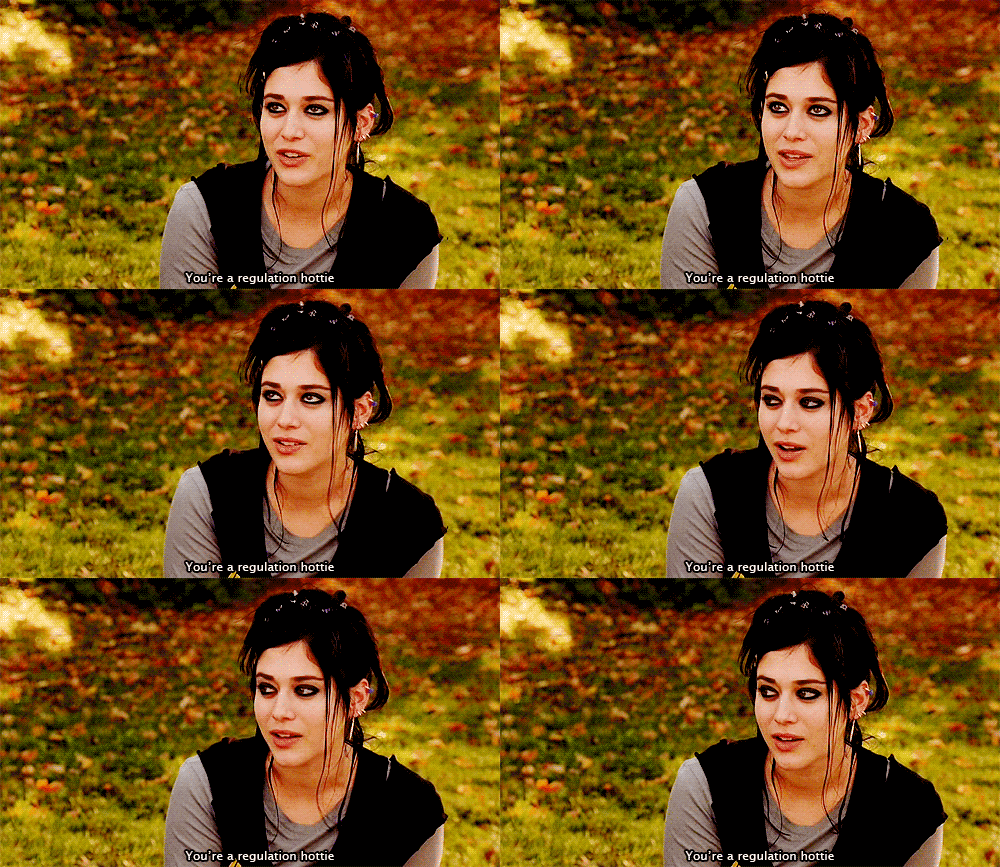
But because Cady is attractive, she is a threat to the Plastics. This is absolutely central to the plot. It isn’t a coincidence that the Plastics invited Cady to sit at the table with them. They noticed her attractiveness. If they subsume her into the group (keep your enemies close), they can control her. If she were left as a free agent, she would earn the attention of the attractive boys (Aaron, for instance), and she would threaten the alpha status of Regina and the Plastics. She would delegitmize them.
The interactions between Cady and the Plastics is something right out of Ender’s Game in its realpolitik. Cady alludes to this when pointing out how she found herself desiring Alpha Regina’s approval even though she hated her, and how Gretchen too chose to be miserable within the Plastics rather than leave it- because the Plastics as a collective are the Alpha group.
(The Plastics maintain their alpha status through attention. Their sexuality and their attractiveness is their chief source of social currency. This is demonstrated in the sexy costumes for halloween, and in the Christmas skit.)

It’s interesting to study the social dynamics within the Plastics themselves. Regina is rightfully Queen Bee because she is the most socially intelligent and manipulative of all. She’s also rich, and drives- all assets that she can leverage. (“Walk home, bitches,” she goes, when her clueless followers side with Cady instead of her, and attempt to use her arbitrary rules- which she instituted to control them and keep them in line- against her.)
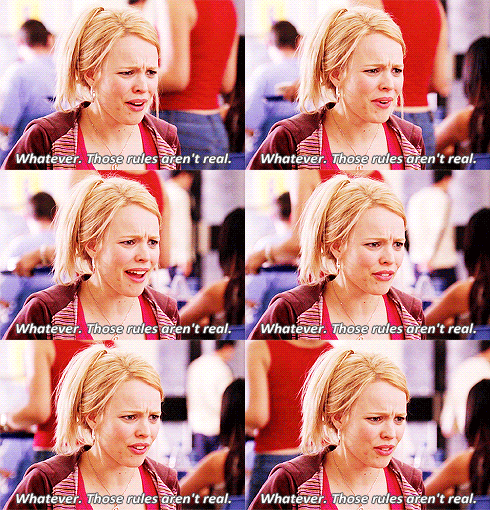

She demonstrates her social intelligence several times, and it’s clear that she derives pleasure from this. The moment that spoke to me the most was when she phoned Cady with “I know your secret,” and then went on to say “Don’t you hate Gretchen for ratting on you?” while Gretchen was on the phone. She deliberately plays people off against each other, manipulating them and their insecurities. She lies to Aaron about Cady. I’d go so far as to say that she built the burn book all along as blackmail capital- it’s a Dead Man’s Switch, which she can use as leverage against anybody who contemplates backstabbing her.
This is what socially manipulative people do- they “store bullets”. It’s like Batman keeping kryptonite in case he ever has to kill Superman. They know a lot about everybody, they have superior information- people like Gretchen (clueless) seek Regina’s approval, and freely divulge information to earn that (supeficial) approval. Notice how insidious Regina is- she got Cady to insult Ms. Sharon in the burn book.
Janis underestimated Cady. While she had nothing to lose by Cady joining her and Damien, she lost Cady to the Plastics. I think this happens a lot with “genuine” people (clueless) who play their cards straight. We assume that our honesty and straightforwardness will be appreciated. Unfortunately, social reality is like poker- there are real stakes involved, and you don’t win by “playing nice”. (Well- different people have different interpretations of how the game ought to be played. Janis and Regina have completely different interpretations. Cady’s interpretation of how to play the social game changes throughout the movie- that’s her personal development as a character, and that’s what makes the movie so goddamn compelling- she experiences multiple different social realities depending on how she wants to play her hand.)
It took a deus ex machina to defeat Regina. She got hit by a bus. This is the “near death” trope- when a player experiences significant trauma and decides they don’t want to play anymore. This is a bit of a copout, and probably a artistic choice for the sake of the limitations of the movie. Think about this- what would’ve happened if Regina didn’t get hit by the bus? Even if Cady decided to “quit the plastic scene”, Cady’s continued existence would threaten Regina’s dominance (as long as Regina cares about her social status). So Regina would have no choice but to decimate Cady altogether. It took a bus to take her out and make her decide that she didn’t want to play.
In my view, there’s no defeating people like Regina in a simple face-to-face confrontation. She has too many assets (her own looks, the attention she gets from boys, and above all, her shrewd understanding of interpersonal relations, people’s insecurities, fears, wants and needs, and all the blackmail content she has).
I suppose maybe Cady could’ve gone the “exile” route and kept to herself and the math kids. That would have been a less satisfactory movie, of course.
As I revisit quotes of the movie, I realize that both of Regina’s followers are “clueless” (in the Gervais principle sense). They are eager for recognition, but they have no real idea of how social dynamics actually work. (Gretchen isn’t being a showoff when she says “I can’t help it if people like me cause I’m popular”- she’s genuinely ignorant of how she comes across when she says that. That’s Posturetalk, not Powertalk.)
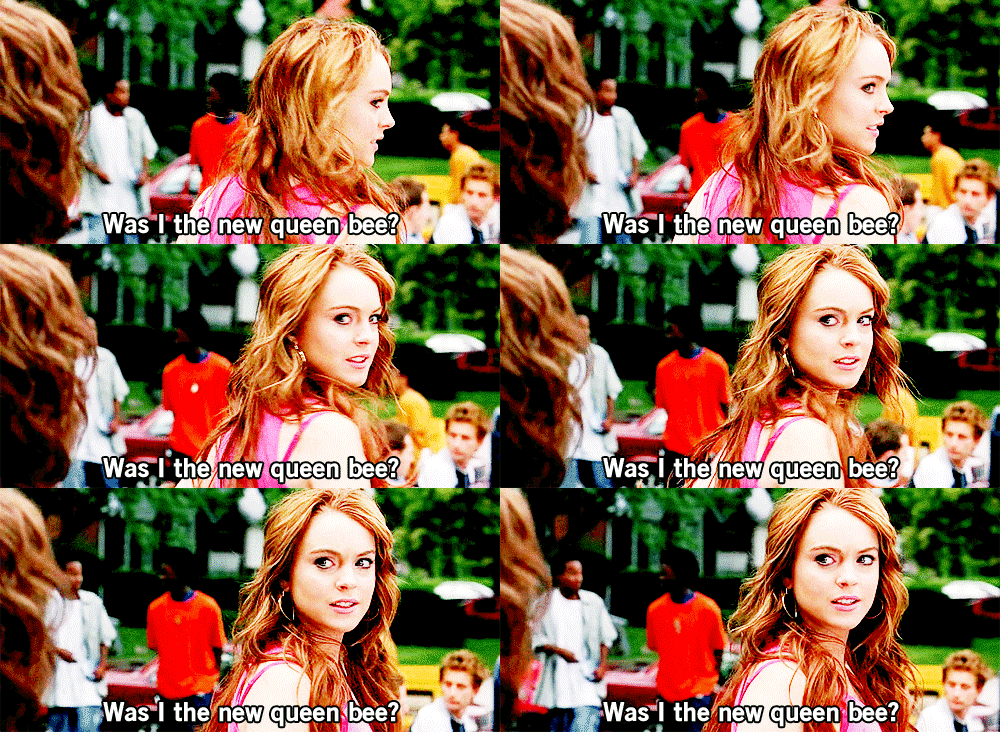
This ignorance of actual social dynamics why they immediately started following Cady around once Regina was out of the picture. Regina is a top dog meant to be followed, while Cady is too inquisitive, analytical and questioning to be an obedient follower. (Consider how Cady wanted revenge when Regina kissed Aaron. Gretchen and the other girl wouldn’t have responded in the same way. They would have conceded defeat and yielded to Regina, and perhaps convinced themselves that it was for the best. “You might think you’re attracted to him, but you’re not”.
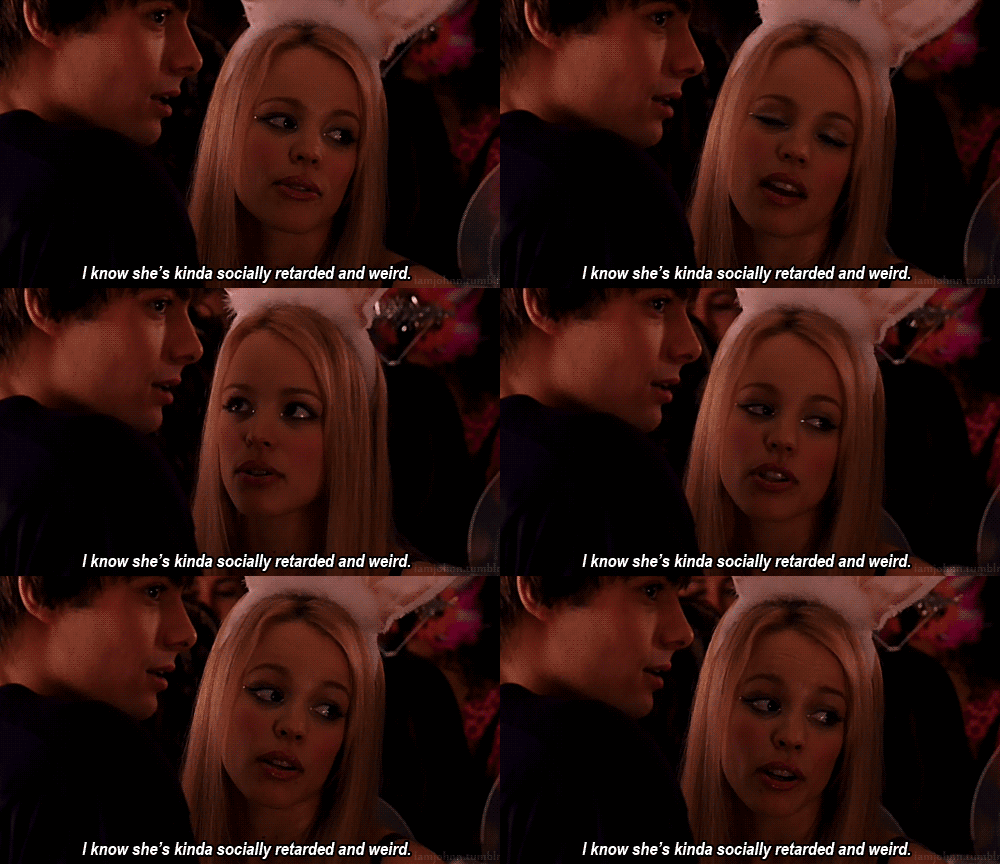
In fact… Regina kissing Aaron was probably Regina’s way of establishing dominance over Cady. I think that’s the simplest and most ratinoal explanation. All Regina really cares about is the pleasure of manipulating others and maintaining her top dog status. She’s used to having followers, and didn’t quite expect Cady to retaliate. (Cady, of course, retaliates partially because she has nothing to lose, and hasn’t been socialized to back down.)
God, what a great bloody film. I could dig deeper into this and tidy stuff up- I think Janis is an interesting character to explore, but I haven’t done much of that here- she might be an example of a Gervais “Loser”- a person who’s typically smarter than the Clueless (Gretchen, Karen), but chooses not to play the game. (Loser in this case is an economic loser, not a social one- so she loses out economically in social currency because she’s not attractive. She demonstrates her wit and intelligence when she outs Cady to Regina in the gymnasium. Everybody relates with Losers- they are the most commonly studied character in sitcoms and films. If you want to understand Clueless- Gretchen, Karen- watch The Office. If you want to understand Sociopaths… Regina’s a great example.)

This is an amazing analysis. The movies that seem surface are usually widely successful because they actually portray deeper themes we experience in life, even if it isn’t always easy to pick up on. I’ve always held that Mean Girls is a deep and interesting movie — beyond its girly-ness and comedy. Many people scoff at this idea, but your article really shows a lot of that depth.
After all, classic novels are often famous for showing social dynamics and human condition — which this movie does indeed. I also am a huge fan of the jungle vs. human/girl world analogies. Those say a lot about humans and animals in terms of: Who is worse? More malicious? More out of line? More outrageous? How do their behaviors differ in the same situation? Are the situations comparable? Are we more savage than animals with the facade of being civil? What does it take to let our inner animal out? And who is to say our way is better?