VVM The Visakanv Megaweb The Visakanv Megaweb

Welcome to theVisakanv Megaweb

Since 2008, Visa has been thinking out loud on the internet, sharing his ideas with the world. The result: a quarter-million tweets, more than a thousand essays and blog posts, and hundreds of videos. The Visakanv Megaweb collects all of it, plus the books and media Visa keeps recommending, into one archive, organized so you can find your way through. Pick a place to start.

262K
tweets
1,251
essays & blogs
459
videos

An archive of Twitter postsby Visakan Veerasamy

Visakan Veerasamy (@visakanv) has been posting on X (formerly Twitter) since 2008, racking up more than a quarter-million posts across dozens of topics. The Visakanv Megaweb organizes them into a single archive you can browse without friction. Explore Visa’s most popular posts, favorite themes, and online network via curated lists. Looking for something specific, or want to browse the archive your way? It’s all here: filters for date, length, and more, plus search across text and handles.

262K
tweets
26K+
threads
36
themes

0194: mvp model of personal development

One Million Words · Productivity · 2014 · 1.1k words

Apply the MVP model to personal development: do the minimum research, aim for the peak experience as fast as possible, and let that success change your identity. The smallest action outweighs endless research.

0194 – mvp model of personal development

Ugh, I just wasted a bit of time before writing this by going on reddit. I got a couple of little links and stuff out of it, but I’d have been much happier to have just gotten the vomit out of the way ASAP. Still, it’s 1020 am. I woke at 7-ish, went for a run, showered, made breakfast for myself and my wife, and now I’m getting started on this vomit. Ain’t too shabby. Let’s just keep going.

Why did I take a bit longer than necessary to start the vomit? What was the source of the resistance? (Btw, The War Of Art has been catalyzing and refactoring my thinking about procrastination and inertia and stuff like that, I highly recommend it. Wish I read it much earlier.) What stopped me from writing earlier?

I think it was partially a lack of clarity. I have a bunch of different ideas in my head all at once, and I think that I wouldn’t be able to do justice to all of them in my present state. So I waffle and procrastinate, as though I’ll have a better state later on. I know by now of course that isn’t true. The athlete will never wake up not aching, not sore. He has to play hurt. So let’s play hurt.

Yesterday I wrote about refactoring my decision-making system, but I didn’t actually get into the details. Let’s try and get some of the details out in this vomit. A couple of things are coming to my mind:

  • One is the way I used to play SimCity 3000 and certain football management games. I used to obsess about the starting point. In Simcity, I’d spend all the starting money building an elaborate system of roads before anybody even moved in. I’d then get slaughtered by the road maintenance bills, and soon lose control of the city. It took me a long time to properly appreciate this, funnily enough. I guess I grew up reading a lot of books, and I never actually DID many things of my own.
    • That makes me think about my first websites. How did I do it? How did I get my first website? I bought a book- some guide to HTML 4.0. One of the first things you do is you open up notepad, type <HTML><HEAD><TITLE>title here</TITLE></HEAD><BODY><P>Hello world!</P></BODY> </HTML> and save that as index.html. Hey, you just made your first webpage! Does that sound silly? Because it isn’t. Where there once was nothing, now there’s something. You now can do something even cooler than your first webpage- you can do your second webpage. And your third, and your fourth. That’s really how you do it, it’s as simple as that.
  • Another is the cupcake model of startup development. In 0178 I talked about “focus on the cupcakes”. I’d like to dig a little deeper into that. What does it actually mean to focus on the cupcakes, when it comes to lifehacking and behavioral change and whatever you want to call it? When it comes to living your life well, getting more out of life?

It’s very interesting and useful I think to apply the MVP model of product development to personal development.
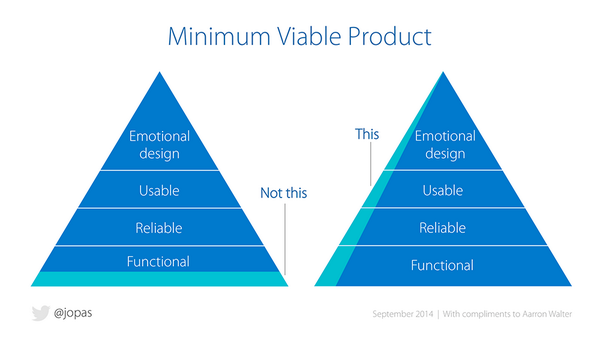
mvp

I spent maybe a decade, maybe more of my time trying to improve myself by accumulating information, which is kinda like the base of the pyramid. It’s tiring, endless and ungratifying. This applies to all sorts of habit building. I focused wrongly on the bottom layer. (On hindsight, this is a lot of what school is about too, isn’t it? Maybe we do things way because that’s how we were taught to do things. What you really want students and learners to do is to experience a-ha moments themselves.)

What you actually want is get to the peak as fast as possible. Energy/willpower is a VERY limited resource early on in any new endeavor. Your subconscious will resist your attempts, because it is very happy at its current equilibrium. Hit the peak, though, and you unlock more energy for your pursuit.

What is the peak? In writing, it’s shipping/publishing something and getting feedback from others, and  changing your identity / self-perception in the process. Changing your beliefs. Deciding/realizing that you’re a writer. In cooking, it’s making a dish, eating it, smiling and realizing that you liked it. You want to get to that point ASAFP. In fitness, it’s breaking a sweat, getting an elevated heart rate, going home and showering and feeling the endorphins. CRITICAL.

Counter-intuitively, this means you should do the minimum research possible. Knowledge is good to have, of course, but it’s not without cost. And the costs are what kill you. That’s what makes a couch potato stay on the couch… opening 20 tabs on his iPad about 20 tips on how to get more fitter better faster quicker. More research = inertia, time-cost, expectations. The more you read up about something without taking action, the more self-conscious you’re going to get. I don’t mean “go unprepared/uninformed”. I mean that going for a walk is 100x more helpful than researching nuances of biomechanics.

You want to optimize for safety and survivability, to make sure that you don’t die or hurt yourself. But once you’ve got that covered, you’re going to learn more from the walk than from the research. The cool thing is that the early experience gives you valuable context to figure out what you should be researching next. This is a compounding advantage you won’t experience if you do the research without the context.

The critical lever might be identity/belief. What’s the smallest/fastest thing you can do to change your identity? That’s real leverage. For me personally, “I’m a picky eater / have food issues / don’t know how to cook” was a big, significant part of my identity. It probably still is. But today I cooked eggs, and they were yummy.

I got my wife to sit next to me and instruct me (I had to remind her several times not to take over- it was critically important that I perform every single step, from getting the plates to taking the butter out of the fridge), which made me feel less intimidated and afraid about the process. (If the idea of cooking eggs being intimidating sounds hiliarious, I don’t blame you. But I grew up without ever preparing food, without even really witnessing food being prepared.)

I’d like to cook eggs again tomorrow. I’d like to get better at it. I’d like to be able to crack eggs smoothly and efficiently, and feed myself every morning.

But that’s just one part of it, really.

Originally published at https://visakanv.com/1000/0194-mvp-personal-development/.

An archive of books and mediareferenced by Visakan Veerasamy

Visa is a prolific consumer of art and media. Over the years, he has referenced, reviewed, and recommended thousands of books, essays, articles, comics, and videos. The Visakanv Megaweb pulls his collection together in one place. Each item carries a link tracing it back to the mention.

About the Megaweb

The Visakanv Megaweb is a public archive of everything Visakan Veerasamy (@visakanv) has put on the internet: a quarter-million tweets, more than a thousand essays and blog posts, hundreds of videos, and the books and media he points to.

Visa has been thinking out loud online since 2008. The result is one of the largest bodies of personal writing on the web, but until now it has lived in scattered places: threads you unroll by hand, blogs on separate platforms, videos spread across years. The Megaweb pulls all of it into one place you can read and search.

What’s inside

The archive is in four parts. The Twitter Archive holds his posts, threads, replies, and quote-tweets. The Writing Archive collects his essays and blogs across three collections. The Video Archive gathers his vlogs, talks, and readings. The Library is everything he points to: the books, essays, articles, and videos he references in his own work.

How it’s organized

Each part is built to be browsed on its own terms. Read a theme from top to bottom, sort by what is most-loved or most-recent, narrow to replies or originals, or search the text directly. Every item keeps a link back to where it came from.

A note on the data

Counts, excerpts, and rankings are drawn from Visa’s public posts. Sourcing and update cadence are still being finalized.

Writer and internet builder, known online as @visakanv. Here are his books, where to support his work, and where to find him.

His books

FAN Friendly Ambitious NerdOn becoming a kinder, bolder, more curious version of yourself.Gumroad →Goodreads →
INT IntrospectAn inward hero’s journey to earn your own trust and self-respect; a remix of Nietzsche, Emerson, Watts, Campbell, and Jung.Gumroad →Goodreads →
An archive of Visakan Veerasamy’s online work.
Set in Fraunces, Geist, and Geist Mono.
Built by Mars Code Factory.
The Twitter ArchiveBest Tweets

Best Tweets

Many tweets from Visa are popular, but some are more popular than others. Browse the 1,000 most-liked top-level posts in Visa’s Twitter archive.

The Twitter ArchiveBest Threads

Best Threads

Visa is known for megathreading, and has written more than 26,000 threads since 2008. Explore his threads, including the longest and most popular. To page through every one, browse the full list →

The Twitter ArchiveLongest Threads

Longest Threads

Visa's biggest megathreads: his longest unbroken sequences, up to 200+ posts. See the best-loved →

204
tweets in the longest thread
7.3
years, longest-running thread
84
tweets, avg. length

The Twitter ArchiveAll Threads

All Threads

Every thread Visa has written: more than 26,000 since 2008. Search the text, narrow by year or length, and sort however you like. See the 1,000 best-loved →

26,381
threads
2021
peak year
102,048
tweets in threads
Search
Length
Year
Theme
26,422 threads

The Twitter ArchiveAll Tweets

All Tweets

Here is every reply, quote-tweet, thread, and standalone post from Visa’s Twitter archive, more than a quarter-million in all. Retweets aren’t included here. Browse all his retweets →

Search
Type
Theme
Year
251,277 tweets

Themes

Visa’s tweets have common threads and narrative arcs if you look closely. Explore the themes he’s focused on across his years on Twitter, and the tweets in each.

Search
36 themes
The Twitter ArchiveRecurring Posts

Recurring Posts

Visa is known for quoting and resharing his own tweets, often to resurface an insight or reinforce an idea. See every time he’s quoted himself or brought an old post back into a conversation.

34,006
self-quotes
13,033
distinct ideas
339
most resurfaced
Search
Year
Theme
4,874 recurring ideas

Retweets

The accounts and posts Visa amplifies. Not his words, but a record of who and what he has pointed his audience toward over the years. Self-retweets aside, here is everyone he has reshared.

Network

If Twitter is a public town square, Visa is the hyperactive, affable guy who talks to everyone: nearly half his posts (45%) are replies to other people. Below are the 100 accounts he replies to most.

Less a body of work than
a body of conversation

The shape of it

Every post and retweet, sorted not by what it’s about but by what it is.

How the mix shifted

His blend of replies, quotes, posts and retweets as a share of each year. Hover for any year.

Volume over time

Themes

What he posts about most. Toggle to see what actually lands.

His network

The accounts he engages with most. Toggle replies, quote-tweets, or retweets; tap a bar to open the account.

…and the same as a bubble field: the top accounts he replies to and quotes most, sized by how often. Hover or tap a bubble.

Hall of fame

All-time records across the archive.

The record-setting tweets

All of Observations & Humor

Every tweet in Observations & Humor. Search the text or a handle, narrow by date or to replies vs. originals, and sort however you like.

Search
Type
Year
16,834 tweets
reply312 likes2026-05-22
original2.1K likes2026-05-20
reply84 likes2026-05-19

placeholder copy and data · this same page serves any scope (a theme, an account)

Search
Year
Datesto

Your bookmarks