The single biggest thing that’s bothering me right now is the following realisation:
1- Every single conversation takes place within some frame. “Conversation” here broadly means any exchange of information. It doesn’t necessarily have to between multiple people– it could be between different aspects of yourself. Short term vs long term, etc.
2- The frame is always limited and limiting. Limited the same way a photograph can only capture one aspect of a moment– everything has to fit within the frame of the photograph, and the picture can only capture one moment of space-time. Limiting because the conversation necessarily has to happen within this frame.
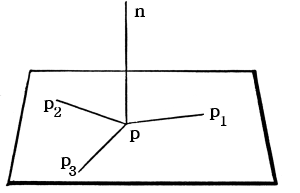
Consider the above picture– a given conversation takes place within the plane where points p1, p2 and p3 all lie on. Most conversations happen on a single point, or a single line– a conversation on a plane is great, it’s interesting. A conversation is EXHILARATING when you can change planes– when you can go orthogonal altogether– in the direction n.
Some conversations are bigger and broader in scope than others, but there’s a bandwidth limitation– you can only communicate so much information with your words, body language, whatever you choose to use as a transmission medium. Great art seems to transcend this limitation, communicating a LOT of information in a little bit of data.
3- Silent evidence is a huge problem. HUGE. Conversationalists are always over represented in conversation. Conversation itself is costly, and there’s a large class of people who are either unable or unwilling to participate in conversation. Rape victims are underrepresented in conversations about rape. Poor people are underrepresented in conversations about social class, public policy and pretty much everything (because they’re too busy trying to survive, or tired from the ordeal.) Women, people of colour and queer folk are underrepresented everywhere.
4- I repeat- ALL conversation is TERRIBLY poisoned by the reality of silent evidence and underrepresentation. Doers are underrepresented amongst talkers and writers. The map is never the territory.
5- When disagreements arise in conversation, people tend to have preexisting ideas about the other parties involved. We tend to seek to confirm rather than to learn more about the other party- this is a natural human bias.
Unless we are totally, fully present in a conversation, we almost always rather get more comfortable than less. (What this suggests to me is that conversations should only be had when fully present, except maybe with very closed loved ones that you trust to be comfortably superficial with. Do not talk about important, complex or meaningful topics– anything where anybody has actual skin in the game– unless you’re totally present.)
6- This is especially bad in online conversations when people are chatting on the side- on reddit, Facebook, Twitter, Hacker News, Quora, wherever. People are typically on these sites during “in-between” moments- while commuting to and from work, while waiting, while avoiding unpleasant and uncomfortable tasks.
We’re typically tired, weary, anxious, troubled, frustrated and looking for shots of dopamine. We want the approval of our peers, because we’re wired for it. Language is a form of social grooming. Getting validation from others is deeply satisfying, probably because it signals to us that we must be doing something right. We want to “win”. This can be troublingly misleading.
7- As collective groups (larger subreddits, later Quora vs early Quora) we first reward things that are witty, funny, clever, snarky, smartass- because these things trigger the aha moments that trigger likes and up votes. Without incredibly strict rules and guidelines, the larger an online community gets, the more it upvotes the trivial, simple and popular. See: The Evaporative-Cooling Effect.
8- This isn’t because the masses are stupid. It’s because the masses are weary and tired. Appreciating complexity is tiring, hard work. Appreciating pop is simple and easy. Life is hard. Most people prefer the simple things most of the time in most cases, except in their area of expertise where they are discerning. There, navigating complexity becomes fun and joyous, not tedious and painful.
9- We are always aware of other people’s oversimplicity in our own areas of specialisation. We are hyperaware of our own specialisations and less aware of everything else. Most people specialise in different things from us. Combine these two facts and you realize why most of the world seems mostly stupid most of the time.
That the world seems stupid is primarily a function of the limitation of the lens that we view it through. through some other lens that we probably don’t possess, we ourselves are stupidest of all.
Perhaps people who are suicidal and self-loathing suffer (at least in part) from lenses that make them look terrible to themselves.
–
So what does all of this mean, what we the implications? How should this affect the way I live my life?
The main thing is to be aware of the intrinsic limitations of conversations. If the people you’re talking to are invested in a certain position, or is committed a certain way, it is:
A- very tempting (and superficially gratifying) to try and persuade them to see things your way
b- difficult if not impossible to achieve- more often than not you’ll both get frustrated and tunnel more deeply into your existing positions, while becoming socially more distant.
This is bad if you’re interested in learning. You don’t learn anything by confirming your own hypotheses. And it’s socially unpleasant– nobody gets happier. Lines get drawn, sides get chosen, the whole thing becomes more tribal.
So what should you do? I think there are two approaches, depending on the opportunity cost (Ask– what else could you be doing with your time?) and your assessment of the value you can get from learning from the other persons. If you’re not interested in learning from the other person, exit the conversation politely and completely. Ideally, don’t get involved in the first place. Acknowledge ignorance.
Otherwise, put down whatever you’re doing, give yourself and the other person the gift of your total presence, and seek to learn from them.
I suppose a middle path– only achievable when you’ve really ingrained the habit so you can do it unthinkingly– is to avoid taking a stance and only ask questions. When people ask you what you think about the economy or God or social issues, say that it’s complicated and you don’t know where you stand. Because honestly, picking a side in advance makes us all dumber. And it also means that people will be guarded and gated, and reveal less information.
So to round up– conversations are inherently limited and limiting, silent evidence is a huge problem. I refuse to take sides, because I don’t know better and I’m only here to learn.
I feel like that’s not a very stable position, and there are definitely going to be loads of things where I have a strong opinion, or where something seems clearly wrong. But instead of declaring “Wow, that guy is clearly stupid”, it would be better for me to imply my position by asking him honest, innocent questions.
I don’t know anything. I just have a few questions.