life as a stressful mess of unfinished projects… inefficient soap placement… flinching at others who bemoan their unfinished projects…
I. well-intentioned mess reduction
Here’s something that my experience has taught me to be true: I can’t do much with stale inspiration. I was going to say “here’s something I believe to be true”, but the truth about my belief here is messier than that. I keep wishing it wasn’t true. I wish inspiration lasted forever. I find it upsetting to accept that that I might have held on to something for too long, to the point that it’s begun to ‘decay’. It’s essentially a ‘sunk costs’ problem, like when the fruits you bought have gone bad. “I thought this was going to be a good idea, and some time has passed and I’m no longer excited about it, but goddamnit I’m going to try and follow through on it regardless!” It rarely, rarely ever works. Mostly it just serves to make me frustrated with myself, my work and my process.
I think part of this is also that… when I was growing up, I endured a lot of preaching and moralizing about the importance of finishing what you start. I didn’t like it, and I wanted it to be wrong, but it seemed like there must be something true about it. After all, I seldom finished what I started, and I generally failed to achieve the levels of success I fantasized about achieving. So it seemed fair to assume that “the reason my life is a stressful, unpleasant mess is that I don’t finish what I start.” From there it felt natural to think, “If only I could finish what I started, my life would not be a mess. Therefore, I should push myself to finish what I start.”
Sounds broadly reasonable, right? But looking back on it all 20+ years later, I see that it was a very clunky and ineffective approach to things, and I’m still paying the price for it, by behaving in ways that don’t actually help me achieve my goals. It reminds me of how easily we get used to some inefficient configuration in our workflow because of some semi-random, arbitrary reasons, and then we just stick with that way of doing things because it’s familiar, and the cost of changing feels too high. And then, when we finally do make the change, our old muscle memory still kicks in and we reach for the inefficient old pattern. I witnessed this play out in a very trivial way that’s nonetheless quite illustrative: where I put my soap.
II. inefficient soap placement
In my bathroom, I had never really thought about where I ought to put my bottle of soap. I just bought it one day and stuck it in the shower and moved on to thinking about other things. But one day I read something about ergonomics that got me thinking about my daily behavior patterns, and I went about my day looking at how I arranged things. And it struck me that, goodness, my soap bottle was positioned in the most tedious possible location on the rack I have hanging on my bathroom wall. To get the soap for my daily showers, I had to twist my arm in a somewhat odd angle to get around other lesser used bottles.
I was in a particularly inspired mood to arrange things better for myself in every aspect of my life, and so I looked at the rack, moved my arm around, and realized that I could put the pump on the near-side of the rack rather than the far-side, making it substantially easier for me to get a pump of soap. I was very pleased with myself for doing this. And still, the next 3-4 times I took a shower, I found myself nonetheless reaching out awkwardly for the old location of where the soap used to be.
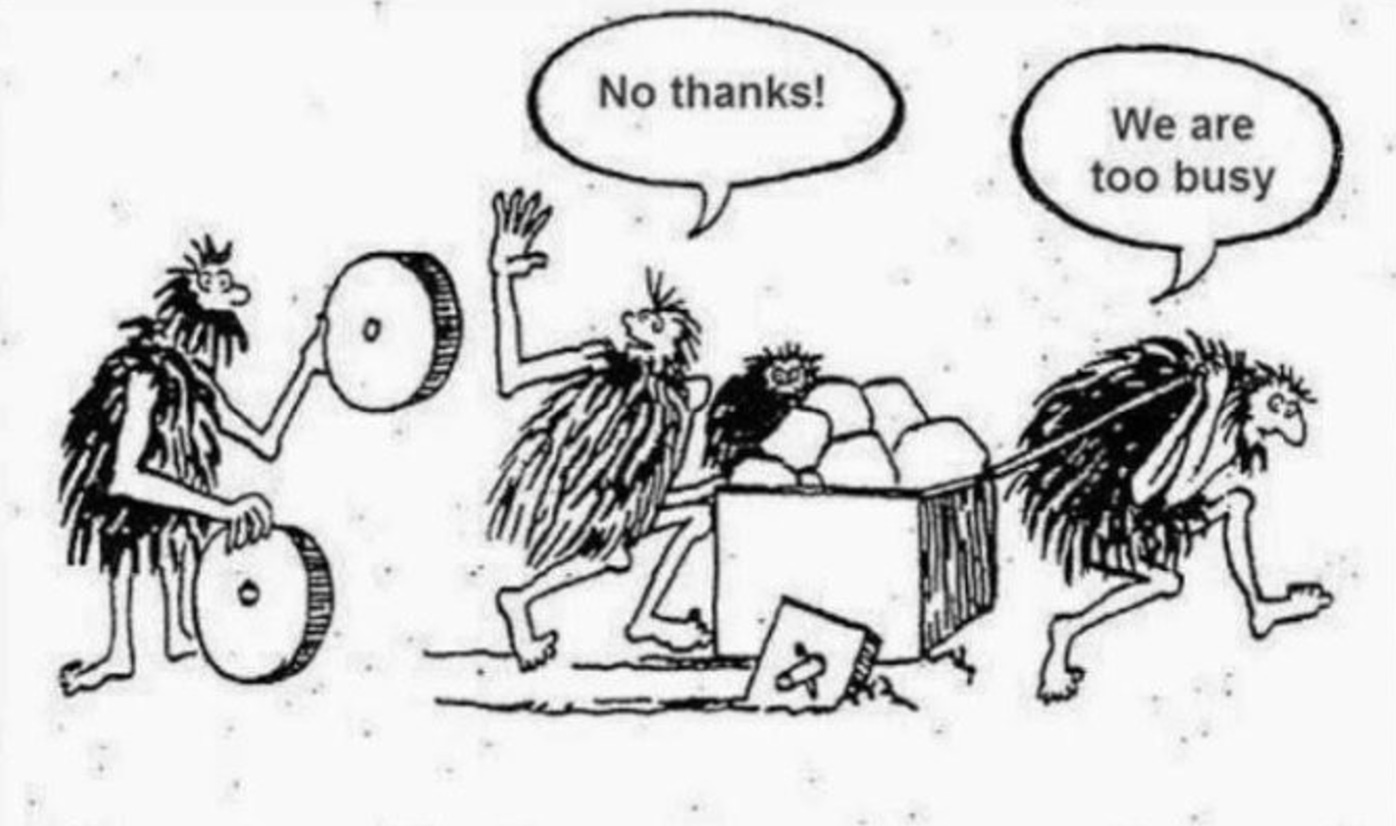
It takes time to adapt to a new system, even if it’s a better system. And there are switching costs to that adaptation. For a period of time, becoming more efficient requires becoming more inefficient. This in turn is now reminding me of an anecdote I heard from a woman who was a competitive swimmer in her youth. I don’t think she made it to the Olympics, but she was winning regional competitions and such. She told me that she had some inefficiencies in her form that she never got around to correcting… until many years after she had stopped swimming competitively, when she was older, and had children, and found herself drawn to swimming again for recreational reasons. This time, since she wasn’t under any particular pressure to perform, she decided to take it slow and really address the issues in her form. Once she did that, she claimed she was then able to swim faster than she ever did.
What a whipcrack of an anecdote! I find myself freshly inspired by it to reevaluate my own behavior patterns. Which is something foundational that I want to really I want to get across here. Inspiration is more like a phoenix than a piece of bread. It might go stale for a while, but it might also
III. flinching from dissatisfaction
Stated by itself, “finish what you start” is obviously a generally good thing. It’s annoying to have lots of started-but-unfinished projects lying around. And I personally feel myself flinching whenever I encounter other creatives who are commiserating about that state of affairs with an attitude of helplessness. I don’t know if that’s something I ought to investigate deeper and address. I’ll mark that as a ‘maybe’.
I do think… if I were in a better state with my own projects, I probably wouldn’t flinch at other people’s responses to their projects. I’d just smile and nod and give them the space they need to work through their own process. But instead I flinch, I think because it reminds me that I’m dissatisfied with my own situation. And then it’s very tempting to transpose my dissatisfaction with myself onto others, and scold them for how they are dealing with their issues poorly, instead of doing the harder work of dealing with my own issues well.
Once I articulate this for myself, the flinch actually tends to dissipate. I can feel it right now. Like, “Oh, I’m actually just dissatisfied with myself. I can address that.”
IV. tunnel vision
That said, I don’t know if “finish what you’ve started before you start something else” is always a good thing. It’s definitely a viable strategy, especially for a certain type of person operating in a certain type of context. But I don’t think I’m that kind of person. I’m someone who likes to do lots of light sketches of something from many different angles in many different styles before I eventually do a ‘final’ product of some kind, if possible. Sometimes I like to try and do something in one fell swoop. Sometimes I like to tinker on a thing for a long time. I think there have been many instances in my past where, if I had not abandoned something that I had started but lost interest in, I would have deprived myself of more interesting and rewarding opportunities that were around me.
Consider the problem of ‘tunnel vision’, where we might be so fixated on arriving at a particular solution to a problem, that we spend lots of time and resources on it, and we fail to notice that there’s actually a different solution to the problem entirely that’s far better. We are once again in “explore vs exploit” territory. I think this is one of those domains where there are no universal rules; there’s always some context where breaking the rules results in a better outcome than following them. And then you can get into meta-analysis about which context is which, and how you might want to spend more time in some contexts and not others, etc etc. The whole time you do this, you wanna be careful not to lose sight of the original goal, even as you hold it somewhat lightly. One of the worst outcomes in the short run is failing to solve a simple but consequential problem, because you spent all your time doing a bunch of analysis instead. But note that I say ‘in the short run’, because in the long run that analysis might actually come in handy. And it’s seldom the specifics of the analysis themselves, but rather the patterns and habits of thought that produced that analysis, that then adapt to the next situation.
Let’s circle back around again. Earlier I said,
… it seemed probable that “the reason my life is a stressful, unpleasant mess is that I don’t finish what I start.” From there it felt natural to think, “If only I could finish what I started, my life would not be a mess. Therefore, I should push myself to finish what I start.”
I added “stressful, unpleasant” after first writing “the reason my life is a mess”, because I wanted to clarify that messes don’t have to be intrinsically bad things. We can learn to be comfortable with some degree of mess. In fact I think many people would acknowledge that there’s something kinda stressful about an environment that’s too immaculate. Like if you go to someone’s house and everything is pristine white; you worry that you might accidentally leave a mark on something. A comfortable environment is one where people don’t have to worry about causing a disruption to some hyper-precise order. A few books and trinkets lying around, a blanket on the sofa that’s imperfectly folded. A little bit of disarray is preferable to rigid perfection.
V. disorientation and ‘wasted effort’
So what was my issue, really? What’s wrong with having a mess of unfinished projects lying around? There are real answers to that question, but looking back I realize I didn’t articulate it properly, and so I was floundering in confusion. The real problem is feeling directionless, feeling lost, having no sense of progression, feeling like all of my efforts were being expended in dissipative ways that amounted to nothing, rather than adding up to something. Once I articulate this– even right now– I feel a sense of relief. Oh, that’s the actual puzzle to solve. I need a sense of direction, something to orient by, some sense of progression, and some sense of cumulativeness. One of the ways I accomplished this for myself in my writing was to start a sideproject called 1000wordvomits, where I set out to write 1000 stream-of-consciousness essays of 1000 words each. I started this project in 2012. There were times where I’d write a lot– I think sometime in 2015 I once wrote over 50,000 words in a single month. And there have been entire months were I wrote nothing. Yet, since the point of the project is simply to write, the main feeling I have when I think about it is fondness, appreciation, respect, admiration, gratitude.
It’s been 12 years and I still have 124 more essays to go. I intend to finish it eventually, but I’m not in a rush to finish it right away. I didn’t know when I was starting out precisely how the journey would go. I envisioned it as a kind of personal odyssey, a journey that would transform me. I said that I looked forward to meeting who I would become at the end of it. And now I can look back and notice that I was a slightly different person roughly every 100,000 words or so. Over the course of the project I got married, got a job, left the job, became self-employed, wrote two books, travelled a few times, had a baby. I’ve just… really enjoyed having this project in my life. I’ll admit, from time to time I do find myself thinking “god I wish I was done with that already”. But I don’t want to rush it, either. Take this piece of writing I’m doing right now. Instead of publishing it on Substack, I could publish it on /1000/, and it would count as 2 wordvomits. But I don’t really feel like doing that, so I won’t. Why? It’s hard to say. It’s just a feeling. Amongst other things, /1000/ has been an experiment in feeling my feelings. Well- really, all creative work is an experiment in feeling your feelings. And living itself is the supreme creative act, for which all other creative work is a kind of rehearsal, or scaffolding.
VI. different contexts
Different people may have different attitudes towards the idea of “finish what you started”, because of the contexts they were in, because of who they inherited that idea from, and all the connotations and so on. Right now I’m thinking of how, in God Of War (2018), Kratos says it to his son Atreus about killing the deer that Atreus had just hunted with his bow. In that context, I’m inclined to support Kratos – you shouldn’t leave that particular job unfinished. The animal is right there, wounded and dying. Finish the job. But outside of that context, when I think about the burdensome way I carried the phrase “I gotta finish what I started…” when it comes to my creative work, it feels more like… insisting on eating food that has already started to spoil. Chances are that I’ll just get sick, in the sense of feeling grossed out by my own work, my own process. I’ve learned from sad experience that once you lose the love and joy in the creative process, it can take a long time to recover. It can be the emotional equivalent of getting injured in training. You’re better off simply not getting injured in the first place. And that means knowing your limits. Which can be difficult to know before you’ve tested them.
As I continue with this particular essay I realize with some amusement that “finish what you started” can also apply not just to particular essays, but even to individual threads of thought within an essay. (((At this point, having written about 2000 words, I now find myself pausing to scan back what’s been written so far. I add ‘partitions’ between sections where I discern them. Next I turn those partitions into subheaders, and I notice that one of those sections is a little sparse compared to the others. I’ll fill that in later. I also look to see if there are ideas that I brought up, that I did not follow through on, that I would now like to follow through on… yes– there’s the bit about goals and typing speed and bottlenecks that I touched on briefly but didn’t follow through on. Do I want to get into it here, or do I want to go back to it and update it there? I think it makes more sense to update. So this section is probably going to be sledgehammered out of existence, or maybe relegated to a footnote.)))
Should I finish every individual thought that comes up in an essay? It’s tempting to say yes. That’s an ideal outcome. But while I was scrolling up and revisiting some of the above sections, I found myself beginning to get weary. I started to slip into the trough of, “eh, is any of this stuff even worth saying? haven’t I said it before already? well, repetition is not intrinsically a bad thing… but maybe this shouldn’t go on the substack?
VII. bringing it home
In the context of this particular essay, in this particular moment, it’s moderately important to me that I finish what I started. I would go to bed feeling more relaxed and comfortable and happy knowing that I wrote something today and published it on my substack, which is a context that I’ve been meaning to develop more fluency in. I would be slightly annoyed that I wrote yet another essay about my creative process rather than one of the more difficult topics I actually want to be writing about, but I periodically find it preferable to publish something instead of nothing. I’m practicing my chops, cultivating my voice, getting into the swing of things.