Do you have a single document that links to every single thing that’s important to you on the web? Why not?
(2024nov: revisiting this, I realize I don’t currently have a particularly strong candidate. Once upon a time it used to be my bookmarks post, but that now feels clunky and dated. It’s tempting to use “I’m a busy parent now” as a defense, and there’s a truth to it… but the thing is I don’t think I was doing a great job of it before I was a parent? I was busy writing my books… this is the kind of question that I use to help people as a consultant, and yet the shoemaker has no shoes. Silly. I’d like to fix this. 2024dec24: fixed! partially.)
✱
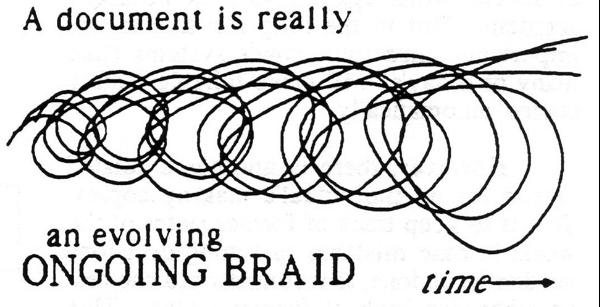
From time to time I find myself saying in conversation, “we haven’t even begun to scratch the surface of what is possible with hypertext”. I believe it is possible to build beautiful cathedrals, cities, universes of hypertext, and we’ve hardly begun. I think Wikipedia is one example of a “hypertext universe” that’s excellent and self-referential. My web of twitter threads is my personal example, and I’m hoping to demonstrate the same with my blog, and my entire body of work, really. And the work that I weave together with other people.
Another thing I say in tandem is “social media is not even 1% as social as it could be”, but I’ll save that for another blogpost.
A hyperlink is simply a link from one hypertext document to another. This simple, lightweight feature is a literal magic portal that transcends the limitations of space and time. But we hardly use it properly. Part of the reason for this, I think, is that we haven’t even really properly gotten around to understanding text itself, the value of text, the power of text. And we haven’t learned to think about documents, files and so on.
Search is a pretty incredible tool, too. I’ve been hearing lately that kids these days don’t think about things in terms of file folders, because they’re used to being able to just search for whatever they want. To some degree, this is what I rely on for my Twitter hyperthreading game – I’m searching my own tweets all the time. And understanding the search has shaped the way I write.
to be continued
✱ ✱ ✱
— previously —
I’ll admit, part of why I’m writing this post is because the word “hyperthreading” is used less than the word “threading”, and I think it’s clever marketing to “plant a flag” in a term that isn’t used very much.
Hyperthreading is not threading + threading, but rather, threading x threading. It’s multiplicative rather than additive. (You could then argue that multiplication is just threading over and over again, I would have to agree with you on that. Still.)
When I google the word “hyperthreading”, it turns out that there’s already a use for it, in computing. It’s “Intel’s proprietary simultaneous multithreading implementation used to improve parallelization of computations performed on x86 microprocessors”. Gosh. I don’t know anything about that. Maybe if I dig into I’ll find some useful details, and I can use computing as an extended metaphor. But I don’t really want to do that. I’m thinking about this in a more abstract, general way. To me, a thread is any sequence of things. So maybe you could also call this hypersequencing. But I like threads, so. Here we are.
I have a tweet where I say “my hyperthreading is an ADHD coping mechanism”, which is true. I write what some people consider to be a ludicrous number of Twitter threads. I have over 150,000 tweets at the time of writing. The following images are from a visualization I got done in May 2020, when I had maybe 100,000 tweets or less. Every “dot” or “square” is a single tweet, every blue line is a thread.
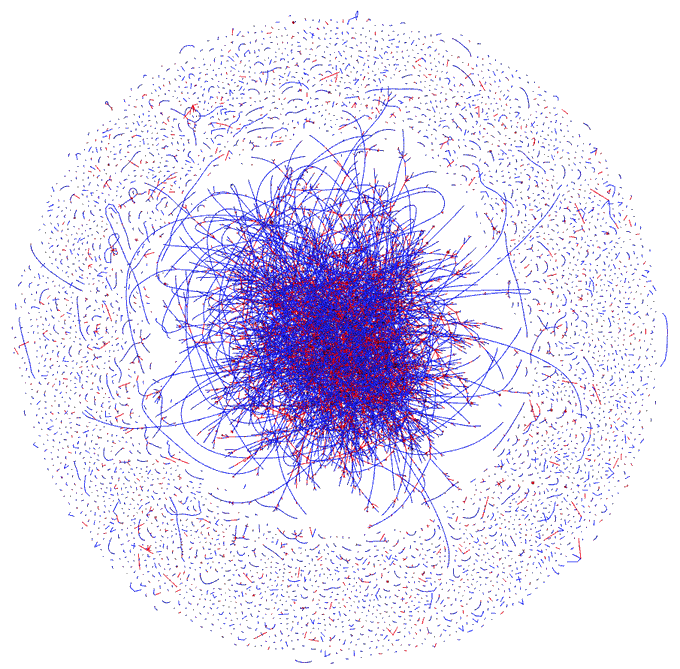
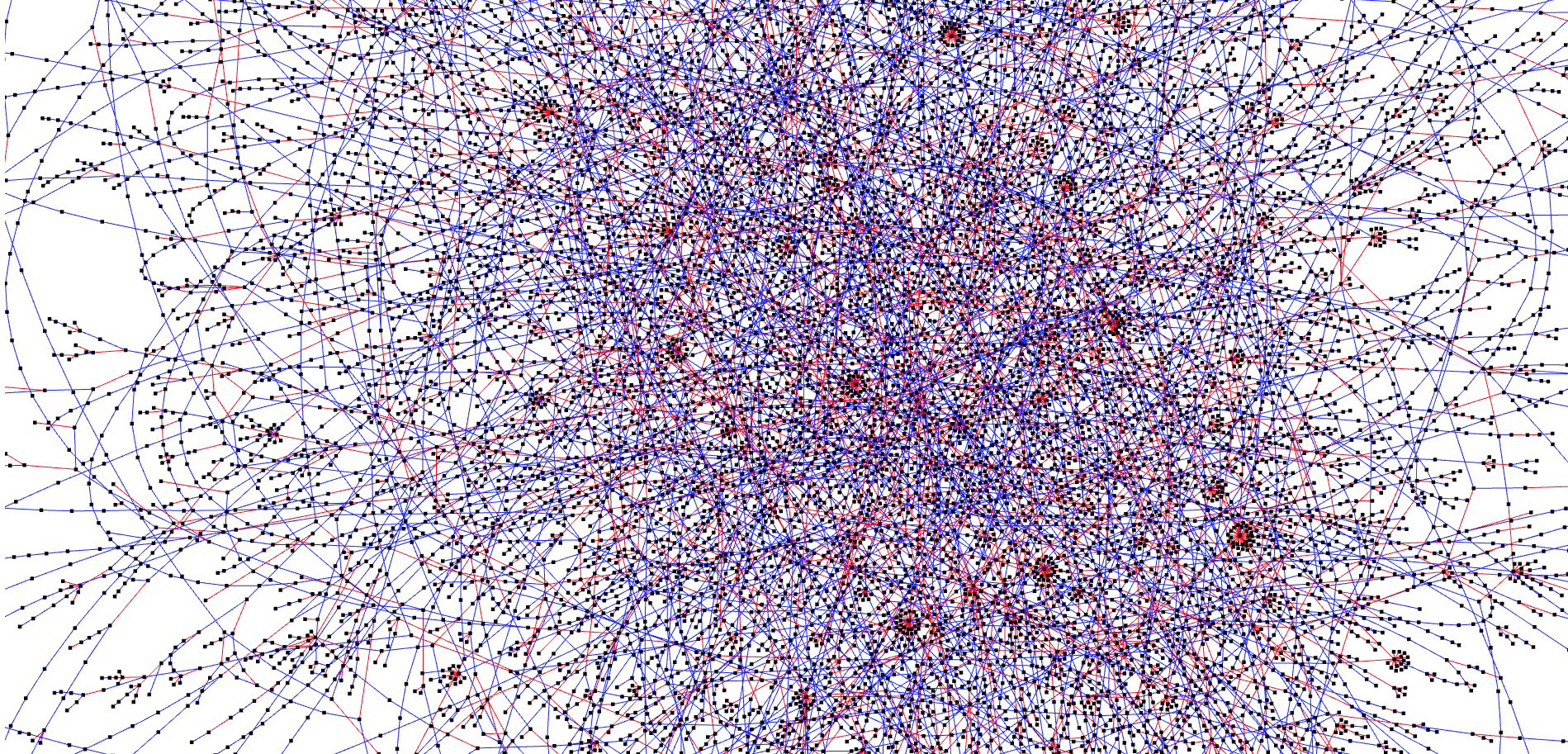
This is what my Twitter looks like. I think that’s a good thing. I wish I could wrangle this chaos a little better, signpost it, tidy it up a little. I don’t expect it to be perfectly polished – mess is part of the process.
An analogy I came up with when talking about my youtube channel, that I really like: it’s like inviting people to a casual showcase in my art studio. I want a bit of a sense of occasion, but I also want it to be informal. Don’t wear fancy clothes, be careful because there’s paint everywhere, but feel free to have a drink, have a laugh, make a mess.
But still, it shouldn’t be absolute chaos.
✱
nov2019: I’ve been making twitter threads for a few years now. It’s kind of my thing. My earliest thread that I still continually reference is “the mvp model of personal development“, written in November 2014.
Everything rests upon Me, as pearls are strung on a thread.”
– Lord Krishna to Arjuna, Bhagavad-gita, Chapter 7.7
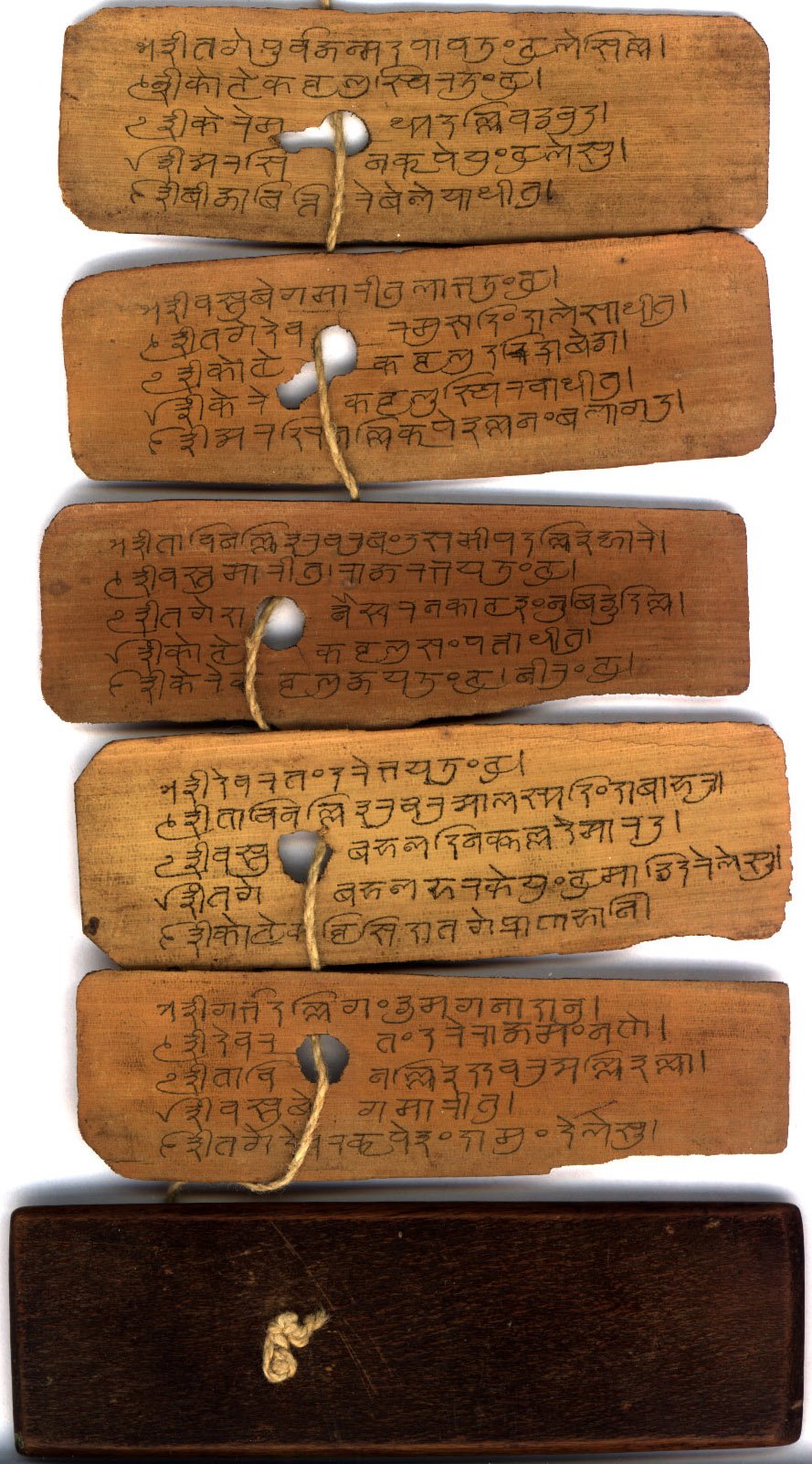
palm leaf manuscript, held together by thread, several hundred years old
In his book The Hero With A Thousand Faces, Joseph Campbell reminds us of the Greek myth of the labyrinth. To fulfil his quest, Theseus needed to go into the labyrinth to kill the fearsome Minotaur – and then, importantly, he needed to get out afterwards. To do that, he used a ball of thread, gifted to him by Ariadne. A bit of string is a trifling little thing, but for Theseus, it was the difference between hope and despair.
✱
The word “sutra” – you’ve probably heard of the Kama Sutra – literally means thread. A Mangalsutra, for example, means auspicious thread, and is the name for the ceremonial necklace that is worn by hundreds of millions of Indian women.
✱
FRAGMENTATION
I had an interesting conversation with a writer friend once about the fragmentation of information. We both agreed that fragmentation isn’t actually a bad thing – what’s missing & needed is better threading. Twitter threads are a specific instantiation of a solution to bigger problem.
What would be ideal, I think, is if all information could be represented as “cards”, and all cards could be easily threaded. Every book, every blogpost, every video, even songs, etc – all could be represented as “threaded cards”. Some cards could be more valuable than others, and be signified as such, like different colored beads on a thread.
A lot of what I’ve been trying to do with my personal knowledge management, notetaking, etc is to assemble an interesting, coherent, useful thread of thread of threads, of everything I care about. A personal web of data, with interesting trails and paths I can share with others.
I have a huge, sprawling junkyard mess of Workflowy notes, Evernote cards, Google keep cards, Notes, blogposts, etc etc ad infinitum. Buried in there are entire books worth of interesting + useful information. But it suffers from bad or non-existent threading, constrained by memory.
When you use search, what you are doing, essentially, is creating an on-demand thread of results (result-fragments).
I write on many different mediums, and over time my twitter style has infected my other mediums. I now blog and Facebook like I’m tweeting. I’ll now be able to find this tweet by searching “infected”. It’s actually modified the way I think to be search-friendly. (Twitter search has dramatically improved my experience of twitter + gets me revisiting &reviewing my old tweets all the time, I think it’s now about 20-30% of what I do on Twitter.)
If you appreciate this well this will even shape your writing – because you’ll write things anticipating the searches of future-you.
After a couple of years, I am extremely convinced: threading is a superpower. It doesn’t actually require much intelligence or skill. You just need to ask, “is this thing relevant or related to any other thing?” – and if it is, you thread it. It takes minimal effort and yields 🔥
My experience playing with threads on Twitter has bled over into several other aspects of my digital life. I now use FB cover photos to thread related FB statuses. I’ve casually begun sorting my iPhone photos into folders. My bookmarks, too. I’m a different person for it.
You don’t have to use Twitter for this. The idea in the abstract is to develop a sense of the things that you’re interested in— by collecting, comparing and ordering them. Once you’ve presented these things, people will even contribute to your collections!
An interesting thing about being a DIY twitter historian is that you get to see how your own thoughts evolve over time. A thing I am slowly learning is that you don’t need to be anxious about forgetting good ideas because they do keep coming back.
While I originally joined twitter to follow other people (I think? It was a decade ago, and I was intermittently inactive for a few years) this is what I love about it as a note-taking tool. Discrete bite-sized thoughts over time, threaded when inspired.
✱
ASSEMBLE THE MINDCITY
Now that more of us are playing the threading game: As we compete+collaborate effectively articulate things we all care about, and weave each other’s thoughts into our respective webs, the desire paths will assemble a mindcity paved with the best individual thoughts.
We used to each aggregate & share our favorite blogs and blogposts, each of which were themselves elaborate thought paths. That was great, but twitter’s killer feature is that each specific thought is both self-contained and modular. The rate of reference & rework is accelerating.
It’s easier than ever to play, and it’s cheaper than ever to make mistakes. You don’t even need to solve entire problems by yourself – partial contributions and partial coinages can be tremendously valuable, because each tweet can function as a setup or a punchline to other tweets.
We used to each aggregate & share our favorite blogs and blogposts, each of which were themselves elaborate thought path. That was great, but twitter’s killer feature is that each specific thought is both self-contained and modular.
The rate of reference & rework is accelerating.
One of my biggest frustrations with the old way – which is what drew me to threading in the first place – was that good ideas from the past get forgotten. Once enough people are combing through threads, the good stuff can continually be resurfaced, & the resurfacing is positive signal.
I’m already seeing a substantial increase in people quote-tweeting each other’s old tweets in response to other people’s tweets. This is exhilarating. IMO the value of each individual tweet and the threads these tweets are in are increasing dramatically as a result.
The race is on to assemble the best possible articulations of ideas in ways that are not just funny or clever, but deeply resonant in ways that make other people want to revisit and reuse them repeatedly.
broke: viral tweet
woke: tweet that’s referenced & reused in many threads
The more people play the threading game, earnestly, directed by their own taste and curiosity and eagerness to share what’s good, the better chances individual tweets have of reaching a sort of semi-immortality. One person’s thoughts can become connective tissue serving thousands.
The important distinction is that thoughts have to be repurposed, reused, referenced, even contradicted. They have to be in play as currency, not frozen into plaques in museums where they languish in a sort of disuse-death.
✱
To be continued.