Me, my wife and our matrimonial Slack
Medium · Romance, Parenting & Family · 2017 · 1.8k words
Visa describes using a shared Slack channel to organize schedules and communication, with an emphasis on kindness and deliberate effort in marriage.
Me, my wife and our matrimonial Slack
Marriage is hard — if you don’t have a system, you’re fucked
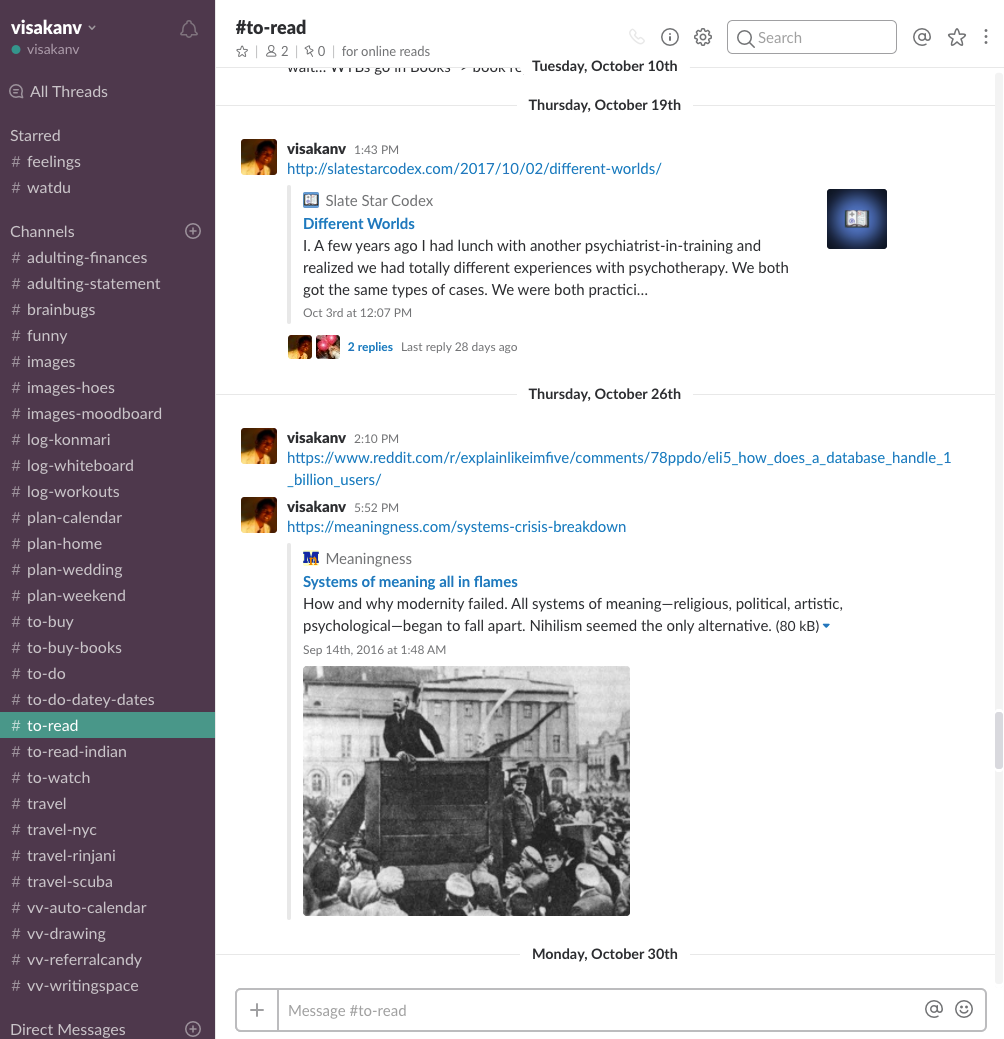
A researcher friend was asking me questions about schedules and marriage, and I think it would be interesting/useful to some of you. A bit of a long read:
(TLDR for the busy: Marriage requires that you be fucking kind to each other and super deliberate and thoughtful and gracious about every little interaction or you’re fucking fucked. Good luck!!! ❤)
How do you organize your schedules?
I’m kind of sloppy about these things. I make plans but I don’t always follow them. I tend to plan social meetups on Facebook Messenger, then add them to my Google Calendar once it’s confirmed. My workdays are defined by my work tools — Trello, Slack, Gcal.
My wife has access to my calendar; she needs to know if I have after-work plans, or weekend plans. We also plan things together sometimes. We figure it out over chat and then we update Gcal accordingly. We also have a personal Slack channel where we go through everything more thoroughly.
It sounds like you put in quite some effort to sync your schedule with your wife’s. is this important to you?
Well yeah, we have a finite amount of time together, so if we’re out of sync it sometimes means someone is left in the dark, unexpectedly alone, lonely without plans.
Once you’re married, there’s a very large volume of things you have to care about — everything from dental appointments and family obligations (two sets!) to household maintenance. Slack is great for this because you can have multiple channels for each concern and not lose track. But you can use whatever; as long as you have a system that works for both of you. (We were both already using Slack at our respective companies, so it was a small thing to experiment with making our own, for fun. And it turned out great.)
Can you tell me a little more about how planning your everyday life compares before and after marriage?
There’s a line from an article that goes, “You’ll find yourself wistful for the days when you had to pay for only your own mistakes.” It’s like that. Each of your mistakes are going to cost both of you now. Sometimes you’re going to do (or fail to do) something, and you don’t just disappoint or upset yourself — you have to deal with the fact that you upset your spouse. Some people can’t deal with this, and get angry at their spouse for being upset. And boom, one of the many spiraling vortexes leading to marital failure.
(By the way, I have a whole set of these reads I recommend for all my friends who are about to get married.)
Before marriage, you are less of a joint unit.
Cohabitation is a big part of that — most Singaporeans don’t cohabit before marrying. But even if you do cohabit, after marriage, you each subtly start to feel more obliged to be a bigger part of each other’s life. (Of course this varies from couple to couple, some married couples are somehow super independent. I know one married couple that’s like long-distance half the time. I don’t know how they do it.)
An evil thought that arises after you’re married & have your first married fight — you don’t HAVE to apologize. You don’t HAVE to sayang & manja them. I mean, you probably will, out of habit, but you could also be like, “fuck it, suffer, I don’t care. Whatcha gonna do, divorce me?”
The fact that the cost of walking away becomes so much higher permanently alters the relationship dynamic.
The cost/benefit calculus. anybody who says this doesn’t affect them at all is either lying or very ignorant (or has attained Enlightenment.)
Also there’s all this family stuff — which of course varies from couple to couple too. Like, if your parents-in-law are being difficult or something, you can’t really be like “Well ok, good luck, not my problem, I’m going bowling with the boys,” or whatever. You’re obliged to deal.
Once you get married, it’s like your relationship is now in a smaller room.
It’s cosier, but you also can’t yell or make as much of a mess as you could before. You could theoretically try, but it almost definitely will hurt the relationship. The skillset that gets you INTO a relationship is very different from the skillset you need to sustain one.
Would you say that you map out ‘unfilled’ time with your wife? how do you plan/negotiate that?
Our default state is a sort of vague coexistence — usually involves both of us hanging out at home and each doing our own thing, me catching up on work or reading/writing. over time we’ve learnt to be more explicit and deliberate about making requests of each other.
We usually discuss things at a “what needs doing?” level, and then once we’ve agreed that something needs doing, we put it in a calendar and try to follow it. Keyword: try. Hahaha.
Something we’ve been trying to be more rigorous about is having explicit time set aside purely for dates or couple time. when you first get married, you’re around each other so much and so focused on each other, it feels like you don’t have to. but you gotta do it. vvv important.
How does explicit couple time differ from “vague coexistence”? why is planning that so important?
Right. It’s possible to vaguely coexist together for WEEKS, waking up, having lunch together while each of you is on your phone, replying to friends, work emails, having dinner together watching netflix, visiting parents, going thru the motions… and subtly drift out of sync.
By “out of sync”, I mean that each of you has a fresh set of concerns and worries that you haven’t articulated to your partner yet, because the mere act of articulation is going to be a tedious process.
That’s when you start responding to questions like “How was work” with “ok la the usual” — because you don’t want to go through the trouble of explaining what was bothering you. (This is why it’s useful to have a #feelings channel in your family slack, so you can just post your feelings as you go… Now that’s a life hack, bizatches.)
Getting “synced up” as a couple is tedious, even when it’s with your best friend of 15+ years. You have to negotiate things. You have to talk about feelings, and frustrations. it’s always easier to be like “aiya later lah, i’m so tired.” You know in advance there’ll be disagreement.
Can you give me an example of friction points and sync difficulty?
A simple eg — say we’re both frustrated with our shitty old sofa + we both know we want to get rid of it. But talking about it means Having A Conversation. bc we each have diff preferences, different styles. I’m happy to toss it + make do. She’d want to review options. Negotiation is tiring, even when you both know exactly what the other person is going to say — because then you kind of have to do this waltz of feelings and considerations. It requires being alert and aware and sensitive to each other. Otherwise it means being disrespectfully dismissive, and that’s the sort of thing that ruins marriages.
So the easy thing for both people to do is to defer the conversation. “Remind me later”. That’s the 2nd worst outcome, you just quietly get increasingly frustrated with the suboptimal mess you call your lives. The worst outcome is a fight, because one person badly wants to do something and the other really doesn’t want to deal with it. How you handle this, while tired af, is the heart of marriage.
& I’m describing one of the simplest, most trivial friction points! Literally Every Imaginable Thing is a potential friction point in a marriage. A sofa is just an object. You’re going to be having intense, difficult conversations about much more personal, contentious things. Imagine if you add kids into the picture! So it’s insanely important that you both be good at doing this, believe whole-heartedly that you’re on the same team, and be kind to each other.
If you don’t have a system You Are Fucked. In the absence of a deliberately designed system, lots of families seem to defer to an improvised system of yelling, screaming, guilt-tripping, emotional blackmail… unimaginable cruelty because of a terrible system of management. It’s very sad.
____
There you go, a tiny little taste of what marriage is like. It’s really hard, but it’s also one of the best things in the world when you get it right. When you’re really in sync (or even when you’re not, but you trust each other to take care of things), you feel really wholesome, fulfilled, nourished.
Feel free to tag your engaged / long-dating / soon-to-be-married / newlywed friends, I know I wish someone had written this sort of thing for me when I was freshly wed~
___
PS: Do 1–1's
Wanted to reiterate — a very clever and effective way of dealing with the inevitability of friction points and sync difficulty is to schedule 1–1 meetings in advance. This is an idea I stole shamelessly from work. Basically, have some time set aside (at least once a month) for the EXPLICIT purpose of discussing difficult things. This has several benefits.
1. You don’t need to feel bad about interrupting your spouse with what’s guaranteed to be a frustrating discussion.
2. It lets you compartmentalize better, so you don’t need to be quietly fuming at each other the rest of the time.
3. It also means that when you’re having an argument, you can just have the argument and not have a meta-argument about how badly you are having the argument. That meta-argument can be had during the scheduled 1–1s.
It might sound oddly bureaucratic, but it’s a huge lifesaver/relief/anxiety-reducer. A lot of couples I talk to tend to get stuck in the meta-argument loop: they have some problem they need to solve, and whenever the argue about it they end up also arguing about how badly they’re arguing — and since they’re already in a bad mood, they struggle to be receptive to one another. Few issues are perfectly 50/50, so getting into a meta-argument always feels like a derailment of the original issue. AND the original issue never gets resolved.
This is a misery I wouldn’t wish on anyone. (And yet it’s probably super common in lots of families.) Compartmentalize your arguments, and schedule time to have them in advance so you’re not caught off guard. It’s also a great excuse to treat yourself to good coffee or beer, and go on long walks, etc.
UPDATE: This post is now part of a broader post on my main blog about relationships!
Follow me on Twitter.
Originally published at https://medium.com/@visakanv/slack-for-spouses-5a91e7140d21.