VVM The Visakanv Megaweb The Visakanv Megaweb

Welcome to theVisakanv Megaweb

Since 2008, Visa has been thinking out loud on the internet, sharing his ideas with the world. The result: a quarter-million tweets, more than a thousand essays and blog posts, and hundreds of videos. The Visakanv Megaweb collects all of it, plus the books and media Visa keeps recommending, into one archive, organized so you can find your way through. Pick a place to start.

262K
tweets
1,251
essays & blogs
459
videos

An archive of Twitter postsby Visakan Veerasamy

Visakan Veerasamy (@visakanv) has been posting on X (formerly Twitter) since 2008, racking up more than a quarter-million posts across dozens of topics. The Visakanv Megaweb organizes them into a single archive you can browse without friction. Explore Visa’s most popular posts, favorite themes, and online network via curated lists. Looking for something specific, or want to browse the archive your way? It’s all here: filters for date, length, and more, plus search across text and handles.

262K
tweets
26K+
threads
36
themes

Pericles

Blog · History · 2021 · 987 words

A profile of the Athenian statesman Pericles, exploring his leadership during Athens' Golden Age, the construction of the Parthenon, and his famous Funeral Oration, presented as a model for contemporary ambition.

Pericles

Pericles (495–429 BCE) was a prominent Athenian general and statesman. He died aged 66, of plague. I find him to be a fascinating historical figure – he’s arguably one of the most important individuals in influencing what some people call The Golden Age Of Athens. If we want to recreate a Golden Age in our lifetimes, studying Pericles’ life seems relevant.

His name meant “surrounded by glory”, and he lived up to it. He was born wealthy and influential, but rather than being a failson he instead challenged and inspired others to greatness. (Heptapolis.com: Pericles was a nobleman with “the bluest blood”… despite this, he was popular with ordinary Athenians and had the rhetorical skills to talk them into doing almost anything.)

Historian Thucydides described him as “the first citizen of Athens”. He promoted arts and literature, and started an ambitious project that built most of the surviving structures on the Acropolis, including the Parthenon.

At the end of the first year of the Peloponnesian war with the Spartans (431 – 404 BCE), he gave a famous speech called Pericles’ Funeral Oration. I personally consider this to be one of the best speeches ever given, and one that puts many contemporary orators to shame. It’s fairly short, everybody should read it.
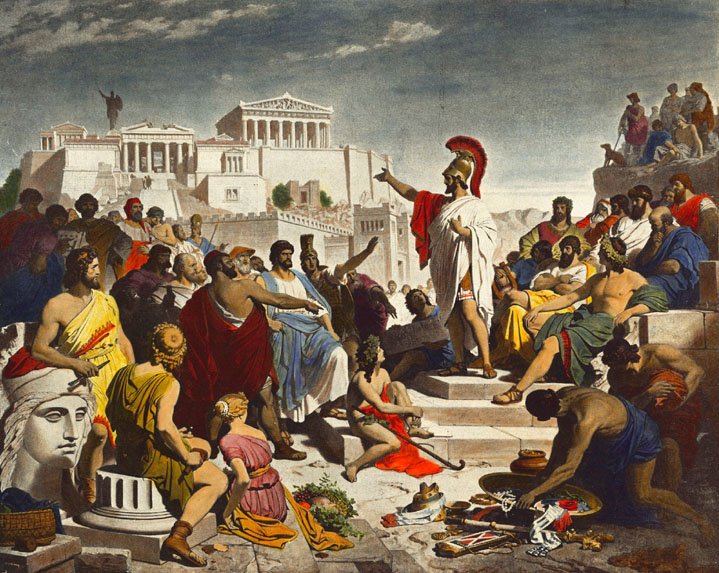
Pericles’s Funeral Oration (Perikles hält die Leichenrede) by Philipp Foltz (1852)

Pericles had many tutors in his life, including Zeno of Zeno’s Paradox fame. (This corroborates with David Banks’ hypothesis that exposure to great teachers at a young age has an outsized effect.)

Pericles had his political opponent Cimon ostracized, ie cast out of town – by acusing him of aiding the enemy (Sparta).

According to Plutarch, Pericles’ lover Aspasia’s house in Athens was an intellectual centre, attracting nerds like Socrates. She had been alleged to have been a hetaira, a sort of highly-educated geisha-esque elite courtesan type? It’s complicated, scholars argue about it.

Consider the role of the Parthenon, which Pericles personally oversaw the construction of – an ambitious, awe-inspiring building to house goddess Athena – the patron and protectress of the city (and citizens) of Athens.

It took 15 years to build (447-432 BC). (Heptapolis: According to Plutarch, who wrote centuries after the building was completed; one of the main reasons for the construction of the Parthenon and the other temples which surrounded it was the need to deal with growing unemployment. By embarking on a major public works program for the acropolis (the towering hill in Athens where the Parthenon and other temples dedicated to the gods were located) Pericles hoped to provide jobs for ordinary Athenians- carpenters, stonemasons, ivory-workers, painters, enamellers, pattern-makers, blacksmiths, rope-makers, weavers, engravers, merchants, coppersmiths, potters, shoemakers, tanners, laborers, etc.)
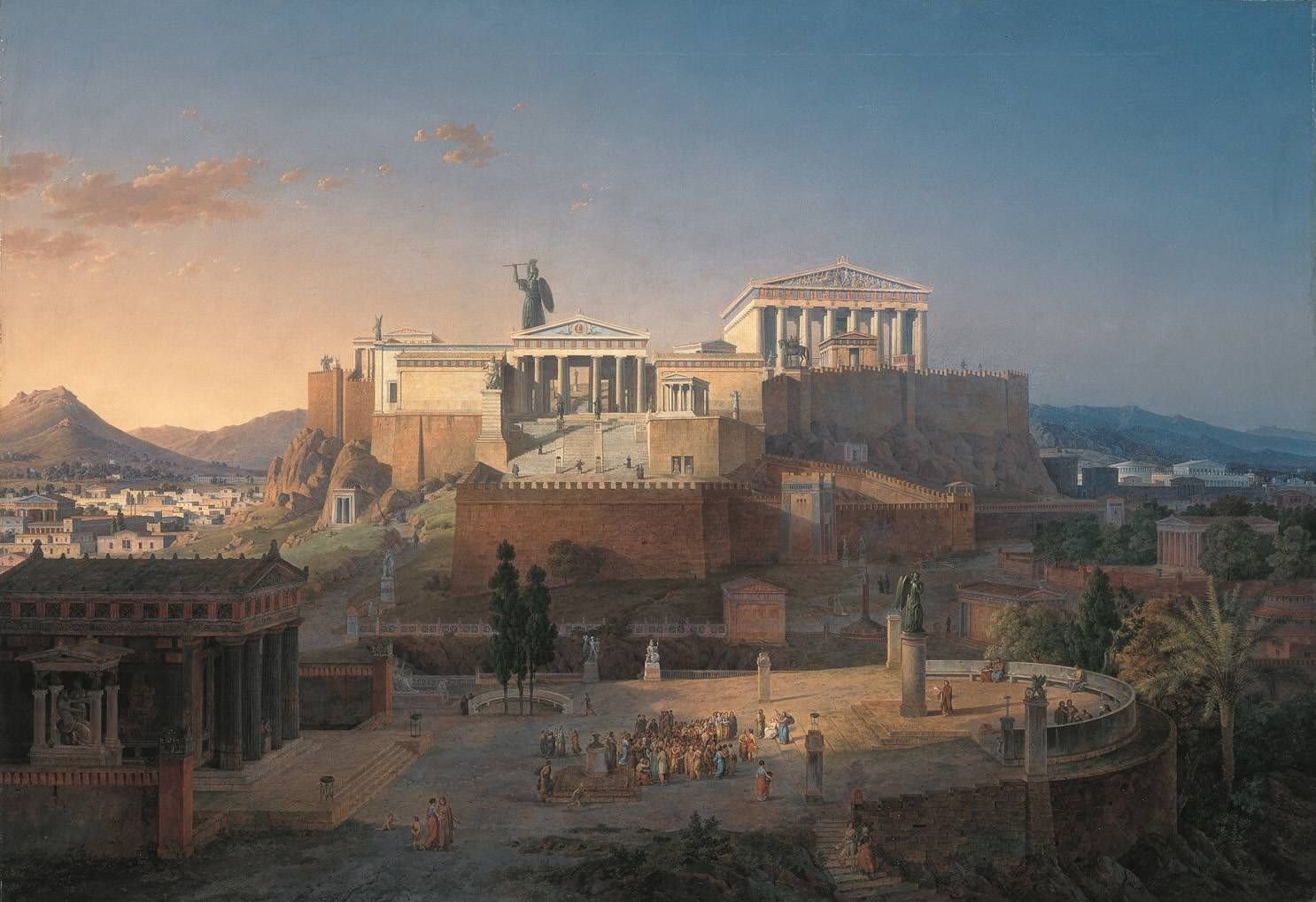
Idealized reconstruction of the Acropolis and Areios Pagos in Athens, Leo von Klenze, 1846

Further reading:

/r/AskHistorians: How was Pericles the ‘ruler’ of Athens if it was a direct democracy?

He was hardly the “ruler”, though he was influential enough that it could be easy to see him that way.

Thucydides, II.65: “Pericles indeed, by his rank, ability, and known integrity, was enabled to exercise an independent control over the multitude–in short, to lead them instead of being led by them; for as he never sought power by improper means, he was never compelled to flatter them, but, on the contrary, enjoyed so high an estimation that he could afford to anger them by contradiction. Whenever he saw them unseasonably and insolently elated, he would with a word reduce them to alarm; on the other hand, if they fell victims to a panic, he could at once restore them to confidence. In short, what was nominally a democracy became in his hands government by the first citizen. With his successors it was different. More on a level with one another, and each grasping at supremacy, they ended by committing even the conduct of state affairs to the whims of the multitude.”

House Of Pericles And Aspasia, Heptapolis.com:

“The Golden Age of Athens was during the rule of Pericles over Athens from 457 B.C. to 430 B.C. During this time the Parthenon was built, Aeschylus, Aristophanes and Sophocles were producing plays in the theater beside the Acropolis and democracy flourished. Pericles ruled over what has been described as the world’s first democracy and mathematics, the arts, history, astronomy and philosophy flourished under Socrates, the Sophists, Herodotus and Thucydides.

During the Golden Age of Greece, Athens was home to about 75,000 people and and between 200,000 and 250,000 lived in the surrounding countryside called “Attica.” The city had an area of about 0.7 square miles.

Under Athens and the Delian League the Greeks ruled much of the Mediterranean and trade flourished. Using iron to make tools, superior ships, weapons and machines Athens grew rich by exporting silver and olives. The money earned from this trade was used to construct other great building and support the arts and sciences.

But things were not always as rosy as they seemed on the surface. A lot of the money used to build the Parthenon was looted from the Delian League treasury, less than a quarter of the population had political rights, slaves were often used instead of machines because they were cheaper, and war with Sparta was imminent. The upper classes ruled the government and many of the democratic reforms, such as payment for jury duty, were attempts to placate the lower classes with welfare payments and keep them in place. In the plains of Attica there only about 250,000 people. The population of the city-state of Athens had would later be reduced by the Peloponnesian wars and the plague from around 80,000 to as a low as 21,000.”

^ Some interesting riffs in here about Pericles’ perspective on the Parthenon, and about using its treasure to finance Athens’ through difficult periods

Also consider: Al-Ma’mun, who strikes me as the Pericles of Baghdad in the 800s.

Scroll to Top

Originally published at https://www.visakanv.com/blog/pericles/.

An archive of books and mediareferenced by Visakan Veerasamy

Visa is a prolific consumer of art and media. Over the years, he has referenced, reviewed, and recommended thousands of books, essays, articles, comics, and videos. The Visakanv Megaweb pulls his collection together in one place. Each item carries a link tracing it back to the mention.

About the Megaweb

The Visakanv Megaweb is a public archive of everything Visakan Veerasamy (@visakanv) has put on the internet: a quarter-million tweets, more than a thousand essays and blog posts, hundreds of videos, and the books and media he points to.

Visa has been thinking out loud online since 2008. The result is one of the largest bodies of personal writing on the web, but until now it has lived in scattered places: threads you unroll by hand, blogs on separate platforms, videos spread across years. The Megaweb pulls all of it into one place you can read and search.

What’s inside

The archive is in four parts. The Twitter Archive holds his posts, threads, replies, and quote-tweets. The Writing Archive collects his essays and blogs across three collections. The Video Archive gathers his vlogs, talks, and readings. The Library is everything he points to: the books, essays, articles, and videos he references in his own work.

How it’s organized

Each part is built to be browsed on its own terms. Read a theme from top to bottom, sort by what is most-loved or most-recent, narrow to replies or originals, or search the text directly. Every item keeps a link back to where it came from.

A note on the data

Counts, excerpts, and rankings are drawn from Visa’s public posts. Sourcing and update cadence are still being finalized.

Writer and internet builder, known online as @visakanv. Here are his books, where to support his work, and where to find him.

His books

FAN Friendly Ambitious NerdOn becoming a kinder, bolder, more curious version of yourself.Gumroad →Goodreads →
INT IntrospectAn inward hero’s journey to earn your own trust and self-respect; a remix of Nietzsche, Emerson, Watts, Campbell, and Jung.Gumroad →Goodreads →
An archive of Visakan Veerasamy’s online work.
Set in Fraunces, Geist, and Geist Mono.
Built by Mars Code Factory.
The Twitter ArchiveBest Tweets

Best Tweets

Many tweets from Visa are popular, but some are more popular than others. Browse the 1,000 most-liked top-level posts in Visa’s Twitter archive.

The Twitter ArchiveBest Threads

Best Threads

Visa is known for megathreading, and has written more than 26,000 threads since 2008. Explore his threads, including the longest and most popular. To page through every one, browse the full list →

The Twitter ArchiveLongest Threads

Longest Threads

Visa's biggest megathreads: his longest unbroken sequences, up to 200+ posts. See the best-loved →

204
tweets in the longest thread
7.3
years, longest-running thread
84
tweets, avg. length

The Twitter ArchiveAll Threads

All Threads

Every thread Visa has written: more than 26,000 since 2008. Search the text, narrow by year or length, and sort however you like. See the 1,000 best-loved →

26,381
threads
2021
peak year
102,048
tweets in threads
Search
Length
Year
Theme
26,422 threads

The Twitter ArchiveAll Tweets

All Tweets

Here is every reply, quote-tweet, thread, and standalone post from Visa’s Twitter archive, more than a quarter-million in all. Retweets aren’t included here. Browse all his retweets →

Search
Type
Theme
Year
251,277 tweets

Themes

Visa’s tweets have common threads and narrative arcs if you look closely. Explore the themes he’s focused on across his years on Twitter, and the tweets in each.

Search
36 themes
The Twitter ArchiveRecurring Posts

Recurring Posts

Visa is known for quoting and resharing his own tweets, often to resurface an insight or reinforce an idea. See every time he’s quoted himself or brought an old post back into a conversation.

34,006
self-quotes
13,033
distinct ideas
339
most resurfaced
Search
Year
Theme
4,874 recurring ideas

Retweets

The accounts and posts Visa amplifies. Not his words, but a record of who and what he has pointed his audience toward over the years. Self-retweets aside, here is everyone he has reshared.

Network

If Twitter is a public town square, Visa is the hyperactive, affable guy who talks to everyone: nearly half his posts (45%) are replies to other people. Below are the 100 accounts he replies to most.

Less a body of work than
a body of conversation

The shape of it

Every post and retweet, sorted not by what it’s about but by what it is.

How the mix shifted

His blend of replies, quotes, posts and retweets as a share of each year. Hover for any year.

Volume over time

Themes

What he posts about most. Toggle to see what actually lands.

His network

The accounts he engages with most. Toggle replies, quote-tweets, or retweets; tap a bar to open the account.

…and the same as a bubble field: the top accounts he replies to and quotes most, sized by how often. Hover or tap a bubble.

Hall of fame

All-time records across the archive.

The record-setting tweets

All of Observations & Humor

Every tweet in Observations & Humor. Search the text or a handle, narrow by date or to replies vs. originals, and sort however you like.

Search
Type
Year
16,834 tweets
reply312 likes2026-05-22
original2.1K likes2026-05-20
reply84 likes2026-05-19

placeholder copy and data · this same page serves any scope (a theme, an account)

Search
Year
Datesto

Your bookmarks