to feel and to fail
Frame Studies · Art & Creativity · 2026 · 2.8k words
The artist's job is to feel their feelings and risk failure repeatedly. Children have beginner's mind, but socialization makes us boring. Art requires discipline, public failure, and scenes that encourage both. Everything else is logistics.
to feel and to fail
that's the artist's vocation for ya
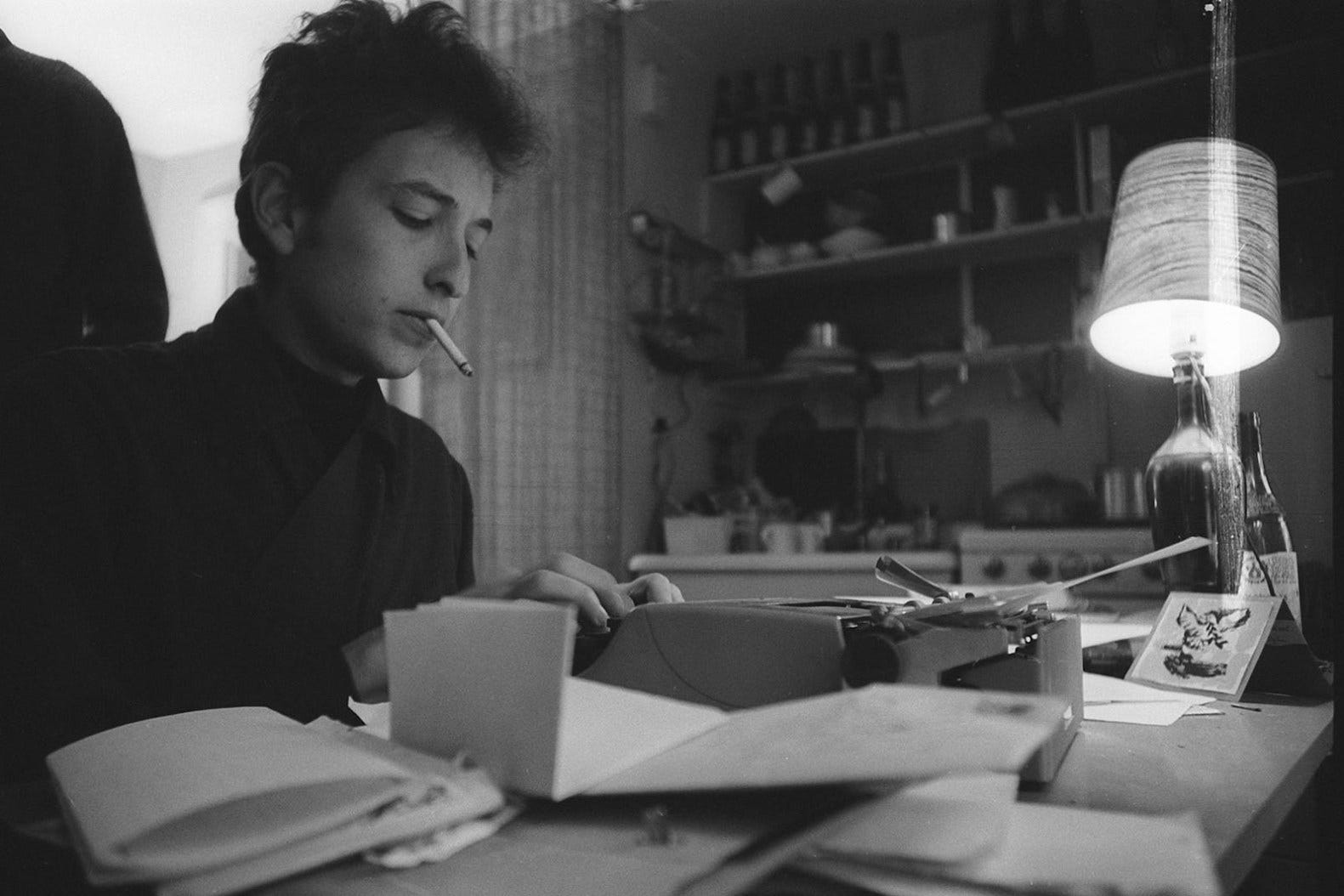
This is the 4th post in my attempt to do 100 daily-ish posts before my 2nd kid is born in July. It’s clunky and messy and tedious, and there are parts I’ve left in because I’ll probably want to revisit them in the future.
I believe that an artist has two critical parts to their work. The first is to feel their feelings, in all their subtlety and splendor. We live in societies, which tend to be crowded, and so as a matter of hygiene and courtesy we tend to recommend that people keep their insides to themselves, in every sense. This works until it doesn’t. Societies also specialize and trade, and just as we have bakers who specialize in making bread and mechanics who specialize in fixing cars, we have artists who specialize in feeling (and expressing) feelings.
Expressing. That’s the second part. There are people who have the artist’s sensitivity, but not their discipline, and they’re trapped in madhouses, or clinging on to bottles, or screaming in the streets. One way or another, their expression is maladapted, excessive for others or insufficient for themselves. And it’s often stuck that way. Everyone (in my world at least) knows some grumpy older checked-out artist like this. They do have feelings. They do have some form of expression. But they’re stuck. They coulda been a contender, but they never got the break they deserved, they never got the right opportunity. Maybe they’re right. Or maybe they just didn’t fail enough. And I don’t mean being stuck repeating the same failure over and over again. I mean trying differently and failing differently each time. That’s harder and more painful to do, especially for a sensitive soul who feels very deeply. But that’s the artist’s life for you. You have to feel and you have to fail. Over and over again.
In yesterday’s post I contemplated Radiohead’s remarkable trajectory from making fairly pedestrian grungy alt-rock to producing a masterwork like OK Computer in under a decade. The question I had is “how did they do it?”, and the answer I got was repeatedly “they followed their anxiety, not their success”, and “they leaned into the discomfort”, or “they avoided doing the obvious easy thing”. In essence, they feeled and they failed, skilfully, repeatedly, masterfully.

✱
A few weeks ago, I brought my 2yo to the library as I often do, and I stumbled upon a copy of Alan Moore’s and Dave Gibbons’ Watchmen (1987). It’s been vaguely on my radar for years, partially because of all the memes and references, and I finally found myself compelled to borrow it and read it.1 I enjoyed reading it at multiple levels– as a casual reader looking for entertainment, as an author studying the craft, and as someone interested in pop culture more broadly.
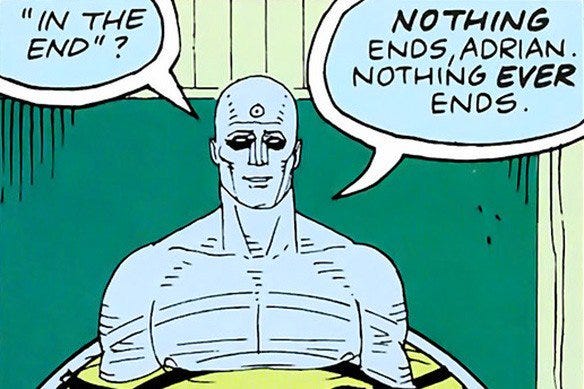
One of the many interesting things about the Watchmen is how strongly it was influenced by Bob Dylan. It wasn’t just a peripheral influence– Gibbons explicitly states in a 2013 forward to the book that a couplet from Dylan’s 1966 song Desolation Row was the spark that ignited Watchmen altogether: “At Midnight all the agents and the superhuman crew / Come out and round up everyone who knows more than they do.”
I’ve never really gotten into Bob Dylan’s music very much myself– I was put off by his style and his vocals– but I’ve always been fascinated by the scope of his influence. He seems to have played a direct role in important transformations for The Beatles, Jimi Hendrix, and arguably even Steve Jobs, who has a couple of quotes about Dylan that I revisit often.
”One of my role models is Bob Dylan. As I grew up, I learned the lyrics to all his songs and watched him never stand still. If you look at the artists, if they get really good, it always occurs to them at some point that they can do this one thing for the rest of their lives. And they can be really successful to the outside world, but not really be successful to themselves. That’s the moment that an artist really decides who he or she is. If they keep on risking failure, they’re still artists. Dylan and Picasso were always risking failure.” – Steve Jobs, 1998 interview with Brent Schlender
People quote Steve Jobs all the time, but they rarely quote the really good stuff, and this is one of his best bangers in my view. There’s a whole useful theory of art in here. If you’re risking failure, you might be making art. If you’re not risking failure, you might still be doing something that people want– you could be an entertainer, but you’re not really making art. AC/DC and Metallica once made art, and now they are mostly tribute acts to themselves. Which isn’t a bad thing to do, either. It’s a happy ending most artists never get to have. There are loads of fans who enjoy their shows still. The touring crew makes a living, and feeds their families. But if we’re serious about art, we have to ask what risks are being taken. And it’s also not necessarily true that paintings, entertainment, etc made without risk are necessarily slop. You can make something beautiful without risking anything, and it can be a nice thing to do, like making trinkets and posters that people like.
But still I think it’s important to think and speak clearly about art, so that we have a better chance of appreciating the next great artist that shows up in front of us– because most of the time, people’s response to great art is to be confused or dismissive. We don’t have the apparatus to comprehend it because it’s too deviant from what we are accustomed to.
✱
There’s a quote attributed to Picasso that goes, “Every child is an artist. The problem is how to remain an artist once he grows up.”2 I have mixed feelings about this. I do think there’s a truth to it. The child has ‘beginner’s mind’, and as Shunru Suzuki said, “In the beginner’s mind there are many possibilities, but in the expert’s there are few.” As a parent of a 2-year-old, I find myself thinking that the quote does somewhat over-valorize children, but I’ll allow it, because I think the underlying point is still underappreciated, and in the broadest sense I’d like a world that values children more than less, even if it goes about it in a clunky way.
Let me elaborate on that. I think the beginner’s mind of the child is underappreciated as something truly valuable. People often say something like this (“Children are natural artists!”) as a way to celebrate kids, but they don’t necessarily then involve the children in important work. They don’t really integrate children into their creative processes, because that tends to be messy and tedious and frustrating. So they’re paying lip-service to it, they way they similarly talk about the virtues of honesty and curiosity and optimism. They’re all things that people think you’re supposed to say are good, but not really go all the way with. I like to say that children ought to make up 50% of philosophy departments, and this always gets a laugh, but I mean it quite seriously.3
So why am I saying over-valorizing? Well— it’s easy for children to be children. And they typically also lack the discipline it takes to consistently make good art. One of my random favorites that pops into my mind all the time is the 8-year-old girl singing “I wonder what’s inside your butthole? Maybe there’s aliens, maybe there’s astronauts…”– and I haven’t seen anything from her since. I know some people might say, well we should celebrate any good art we get, however fleeting it is, and not expect anyone to commit to an artist’s life just because they made good art once. I do agree. But I also think there are things that we can only get from people pursuing artistic vocations over entire lifetimes– just as a tree is more than just a collection of individual leaves and branches, an artist is more than a collection of artifacts. A thousand random pieces of art can be nice, but it’s not the same as a thousand works from one artist. (I might elaborate more on that separately.)


To recap: I want people to appreciate art, appreciate beautiful things, respect the beginner’s mind, encourage children, encourage everyone, and appreciate the value of discipline. I’m not claiming to be great at any of these things; all of it is aspirational for myself first and foremost.4
✱
“Every book is a failure.”
– George Orwell, Why I Write (1946)
It’s interesting to juxtapose “children are artists” that with Jobs’s view that to be an artist is to risk failure. Because… do children know they are risking failure? Are you really risking failure if you don’t even know that you are? I think the answer is “kind of, but not really”. Young kids are trying things all the time, including things you’d really prefer them not to try, like eating food off the floor, and reaching their hands into gross places you wouldn’t even think to.
Children tolerate failure more than adults do. There are a bunch of reasons for this. One reason (which feels like “cheating”) is that don’t even really have a concept of failure yet. They just do things and try things. One thing I’m always struck by is how my 2yo son will spend a long time assembling something, like say a jigsaw puzzle, and then immediately destroy it, without even really pausing to appreciate it. And he’ll enjoy messing around with things that don’t seem to have any utility whatsoever. These messes can be really annoying, and even as someone who tries to nurture the artist in everyone, I can get quite frustrated at having to deal with the messes. I will say, it’s worthwhile creating contexts in which messes can be made safely. And I think that generalizes beyond child-rearing.
✱
I want to bring up one final artifact for your consideration: one of my favorite pieces about childhood creativity, The Average Fourth Grader Is a Better Poet Than You (and Me Too) [2013], by Hannah Gamble. I first read this in 2019, and it’s really stuck with me ever since.56
Hannah spent time discussing poetry in classrooms with kids aged around 8-11, and found that the younger poets were better at poetry than older kids ~(12 and up). I’ll quote my favorite parts directly:
These young writers are addressing subjects that still obsess poets fifty years older: sadness, death, love, responsibility, aging, family, loneliness, and refuge…and they are addressing these subjects in language that is new, and thus has the power to emotionally effect a well-seasoned (/jaded) reader. The average fourth grader is able to do this because she hasn’t been alive long enough to know how to do it (and by “it” I mean talk about the world) any other way.
By middle school/high school, the average student has learned how normal people talk. The resulting language is underwhelming and predictable—the safe regurgitations of a thoroughly socialized consciousness.
While the average older student’s poems are heavy with allegiance to a limited view of reality, the average younger writer’s vision of the world is nimble and surprising—bizarre, yet true.
I quote these so, so often. It’s socialization that makes us boring. It’s striking that in a children’s book that has cars in it, you’ll see all sorts of colorful cars, but you go out into a parking lot and you typically see 50 shades of grey.


default-encouraging vs default-discouraging
The last thing I want to think and talk about today is how we tend to be default-encouraging to kids who are trying and failing at anything. With some things like eating and walking and pooping, we simply assume that the kids are supposed to be able to get it, and treat them as such, and they inevitably learn to do it. And there are some contexts– I’m thinking of musical families, and circus families, where kids are raised amongst highly competent adults who casually assume that they’ll be able to sing complex harmonies or do a double backflip. And so they do that. If you’re raised by acrobats, you’re going to be casually competent at acrobatics, even if you don’t really have that much of an interest in the circus, and run away to become an academic or something.
We aren’t default-encouraging to adults, not generally. There are a lot of popular mainstream sentiments like, if you can’t sing or dance, you probably shouldn’t bother trying. Don’t embarrass yourself, right? Unless you find your way into a little bubble environment– ideally a scene– where feeling and failing is encouraged.7 I have a ton to say about how, if you look at human history, you might think that progress is probably kinda steady and linear, but when you look closer, you see that it’s really not. Progress of any kind happens in tremendous leaps and bounds in very small clusters of space and time, at the hands of remarkably small groups of people. And it’s in spaces where people encourage each other to think and feel and fail, publicly. These scenes are magical and generative. Practically everything good that we have in the world comes out of this understanding. And yet this understanding itself often seems weirdly fragile. It’s usually present at the founding of any great organization, but it seldom endures for very long. Why is that?
Y’know what, I’ve said enough for today, so let’s get into that tomorrow. Thanks for reading.
I think I was particularly primed for it because I had recently caught up on The Boys and Invincible, both superhero TV shows based on comic books that are particularly critical of superheroes. I got the sense (correctly) that Watchmen was an important predecessor to those works.
It’s unclear if he ever actually said this, but he did write in a letter in 1956, “It took me four years to paint like Raphael, but a lifetime to paint like a child.”
I recently found out Nietzsche had a similar quote. Man, I’m always reinventing Nietzsche by accident:
“Ought it to be the task of philosophy to reconcile that which the child has learned and the man has come to know? Ought philosophy to be the special task of youths, since they stand midway between child and man and have needs common to both? It almost seems so, if one considers at what age philosophers nowadays usually produce their grand idea: at an age when it is too late for belief and still too early for knowledge.” Nietzsche, Daybreak, Book V Aphorism #504
The discipline thing in particular is probably my weakest link, as a few beloved friends have painstakingly tried to convey to me. Thank you! I’m working on it!
I particularly love the phrase ‘thoroughly socialized consciousness’, and reuse it repeatedly as often as I can in as in many different contexts as I can manage.
This rhymes with what Henrik Karlsson talks about in Being creative requires taking risks (2026): “When children learn to draw, they tend to make more and more interesting images for several years until around age five, when they learn to be boring.”
There’s a great line from an economics professor about how he learned more Nepalese in a few months with the Peace Corp in 13 weeks than Spanish in school in ~4 years. Actually, this really points to how bad we are as a species at teaching anything. We’re so early to everything.
Originally published at https://visakanv.substack.com/p/to-feel-and-to-fail.